
Culture · Early Archaic
Archaic (Eastern)
8000–1000 BCE, North America — Eastern Woodlands
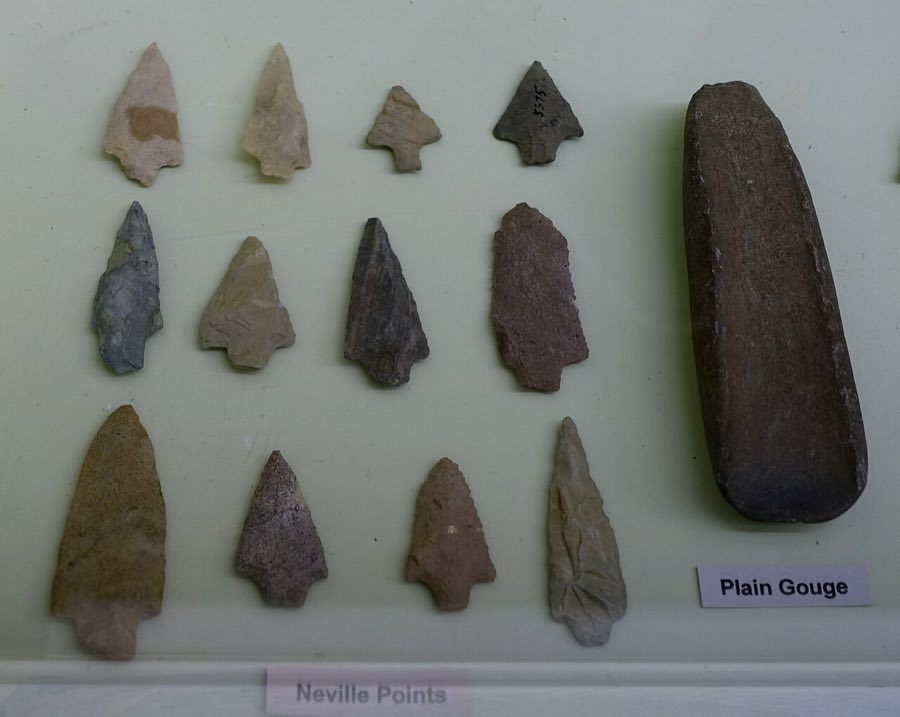
The Eastern Archaic is a broad label for the hunter-gatherer societies of the eastern United States between about 8,000 and 1,000 BCE, before pottery and burial mounds became common. Over seven millennia it saw the introduction of notched points, ground-stone axes, atlatl weights, steatite bowls and, late in the period, the first domesticated plants. Collectors hold the largest share of their material from this era, from Kirk and Thebes points to bannerstones, grooved axes, plummets and pestles.
| Dates | 8000–1000 BCE |
|---|---|
| Period | Early Archaic |
| Region | North America — Eastern Woodlands |
| Areas | Eastern United States |
| Typical objects | Projectile point, Grooved axe, Bannerstone, Drill, Plummet |
| Typical materials | Chert, Flint Ridge flint, Fort Payne chert, Dover chert, Quartzite, Banded slate |
Identification
Early Archaic material is dominated by large corner-notched, side-notched and bifurcate points with ground bases and serrated or bevelled blades. Middle and Late Archaic assemblages add full-grooved axes, winged and butterfly bannerstones, birdstones, plummets and broad stemmed points such as Savannah River. Banded slate, Flint Ridge, Fort Payne and quartzite are typical materials, and shell middens and pit-house sites are common contexts.
Legality
In the United States, prehistoric artifacts may be collected and sold only when they come from private land with the landowner's permission; removal from federal, tribal or most state land is prohibited under ARPA and state statutes. Funerary objects, human remains and sacred items are covered by NAGPRA and are not legitimately traded, and Canadian provinces treat archaeological finds as Crown or provincial property. Bannerstones and birdstones in particular were often grave goods and can be subject to NAGPRA claims when their find context is known.
Reproductions and fakes
Bannerstones and birdstones are heavily faked because of their value; fakes are cut on power tools and show straight, uniform drill holes, lack the incremental rings of a reed-and-sand bore, and have a polish that does not follow the banding. Large Archaic points are replicated in heat-treated chert and artificially patinated. Ground-stone axes are also recut from damaged genuine pieces and re-polished.
Cite this article
Stratum Strata. "Archaic (Eastern)" (Culture). Stratum Strata pack 2026.09, as of 2026-09-21. https://stratum.black/strata/cultures/archaic-eastern. Accessed 2026-09-21.
@misc{stratum-archaic-eastern,
  title        = {Archaic (Eastern)},
  author       = {{Stratum Strata}},
  howpublished = {\url{https://stratum.black/strata/cultures/archaic-eastern}},
  year         = {2026},
  note         = {Culture article, Stratum Strata pack 2026.09, as of 2026-09-21; sources: stratum, commons. Accessed 2026-09-21.}
}
Citations carry the pack version and the article's as-of date so they resolve to the same text later. The facts themselves belong to the sources listed below; cite those for the science.