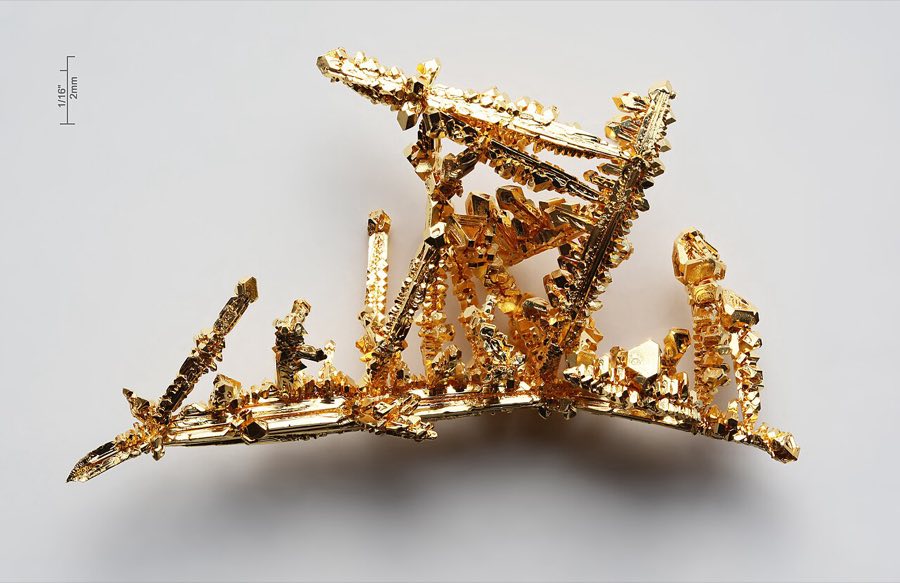

Material · metal
Gold
Europe — Mediterranean, Europe — Western & Central, Egypt & Nile Valley, Central Asia & Steppe, South America — Andes
Gold was worked from the fifth millennium BCE at Varna and in Egypt, Mesopotamia, the Aegean, the Andes and the steppe, for jewellery, coinage, vessels and funerary art; it does not corrode and survives perfectly. Egyptian, Scythian, Etruscan and Andean gold are the great categories, and coins from Persian darics to Byzantine solidi are widely collected. Gold is subject to Treasure law in Britain and to strict patrimony law elsewhere.
| Kind | metal |
|---|---|
| Regions | Europe — Mediterranean, Europe — Western & Central, Egypt & Nile Valley, Central Asia & Steppe, South America — Andes |
Sources
Ancient gold came from Nubia, the Eastern Desert of Egypt, Anatolia, Thrace, Dacia, the Iberian rivers, Ireland, the Altai and the Andes. Most ancient gold was panned from placer deposits rather than mined from veins.
Identification
Ancient gold is alloyed with silver and copper in varying degrees and shows a soft, warm colour, hammer marks, granulation and filigree; wear on high points and a faint reddish surface enrichment mark genuine pieces. Modern gold is uniform in colour and finish. XRF gives fineness.
Substitutes and fakes
Gold jewellery is faked in ancient styles using modern alloys and electroformed from originals; granulation done with modern solder is a key tell. Gold coins are struck and cast as fakes, and provenance is critical because of Treasure and patrimony law.
Elsewhere
- Wikidata: Q897
- Wikipedia: gold
Cite this article
Stratum Strata. "Gold" (Material). Stratum Strata pack 2026.09, as of 2026-09-21. https://stratum.black/strata/materials/gold. Accessed 2026-09-21.
@misc{stratum-gold,
  title        = {Gold},
  author       = {{Stratum Strata}},
  howpublished = {\url{https://stratum.black/strata/materials/gold}},
  year         = {2026},
  note         = {Material article, Stratum Strata pack 2026.09, as of 2026-09-21; sources: stratum, wikidata, commons. Accessed 2026-09-21.}
}
Citations carry the pack version and the article's as-of date so they resolve to the same text later. The facts themselves belong to the sources listed below; cite those for the science.