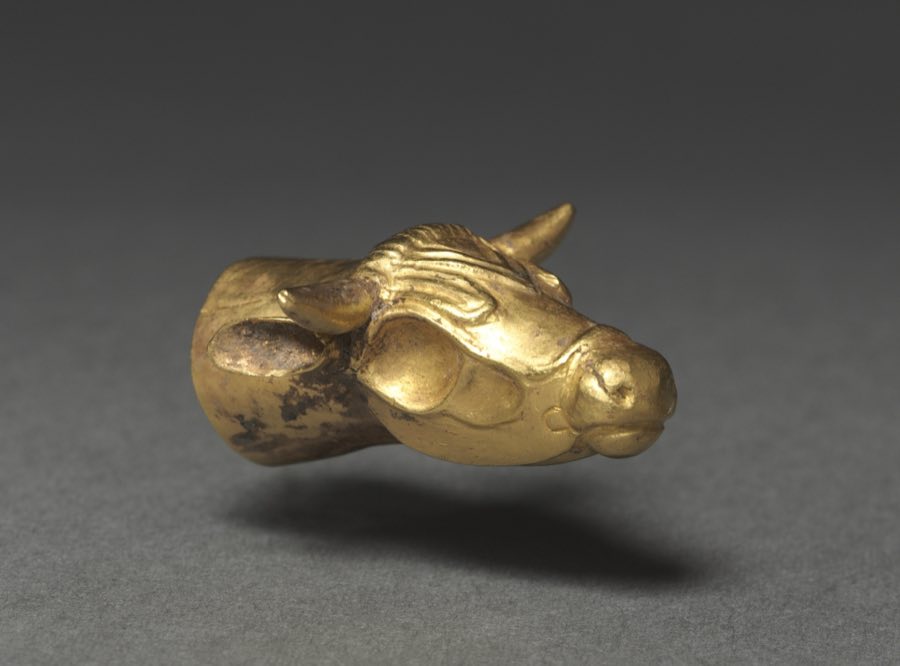
Culture · Iron Age
Thracian
1000 BCE–46 CE, Europe — Western & Central
The Thracians were the Iron Age peoples of the eastern Balkans, known from Homer onward and organised under the Odrysian kingdom from the fifth century BCE until Rome annexed Thrace in 46 CE. Their aristocracy was buried under great tumuli, at Kazanlak, Sveshtari and the Valley of the Thracian Kings, with gold and silver drinking sets, horse gear and Greek imports, and the Panagyurishte and Rogozen treasures are the most famous finds. Thracian art mixes Persian, Scythian and Greek styles in repoussé silver and gold. The market sees fibulae, bronze appliqués, silver-gilt horse trappings and coins of the Thracian kings and tribes.
| Dates | 1000 BCE–46 CE |
|---|---|
| Period | Iron Age |
| Region | Europe — Western & Central |
| Areas | Bulgaria, Northern Greece, European Turkey, Romania (Dobruja and Wallachia) |
| Typical objects | Vessel, Bowl, Coin, Sword, Spearhead, Brooch, Bracelet |
| Typical materials | Gold, Silver, Bronze, Iron, Terracotta |
Identification
Thracian-type fibulae with a knobbed bow, silver phalerae with animal-combat scenes and rhyta with animal-head terminals are characteristic; Scythian goldwork is more purely animal style, and Greek imports are of Attic fabric. Thracian coins include imitations of Philip II and the tribal issues with the Thracian horseman.
Legality
Bulgaria's Cultural Heritage Act (2009) declares all archaeological objects state property, requires registration of private collections and criminalises unregistered trade; Bulgaria has a CPIA agreement with the United States (since 2014) covering objects from prehistory to 1750 CE. Romania's Law 182/2000 and Greek Law 3028/2002 protect Thracian material in those countries. Tumulus looting in Bulgaria is extensive and freshly looted silver and gold appliqués are a frequent problem on the market.
Reproductions and fakes
Thracian silver-gilt appliqués and rhyta are forged in Bulgaria to a high standard, sometimes using ancient silver; genuine repoussé shows tool marks on the reverse, cracking of the gilding and wear on the projecting parts. Coins of Thracian kings are cast in modern copies.
Elsewhere
- Wikidata: Q144964
- Wikipedia: Thracians
Cite this article
Stratum Strata. "Thracian" (Culture). Stratum Strata pack 2026.09, as of 2026-09-21. https://stratum.black/strata/cultures/thracian. Accessed 2026-09-21.
@misc{stratum-thracian,
  title        = {Thracian},
  author       = {{Stratum Strata}},
  howpublished = {\url{https://stratum.black/strata/cultures/thracian}},
  year         = {2026},
  note         = {Culture article, Stratum Strata pack 2026.09, as of 2026-09-21; sources: stratum, wikidata, cleveland. Accessed 2026-09-21.}
}
Citations carry the pack version and the article's as-of date so they resolve to the same text later. The facts themselves belong to the sources listed below; cite those for the science.