
Culture · Iron Age
Etruscan
800–100 BCE, Europe — Mediterranean
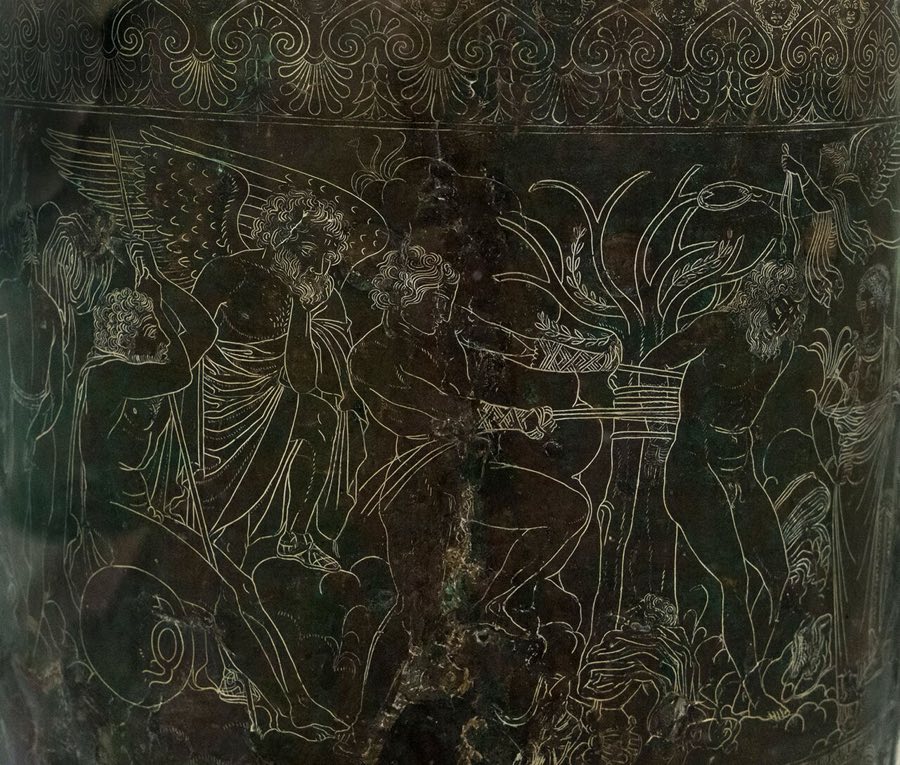
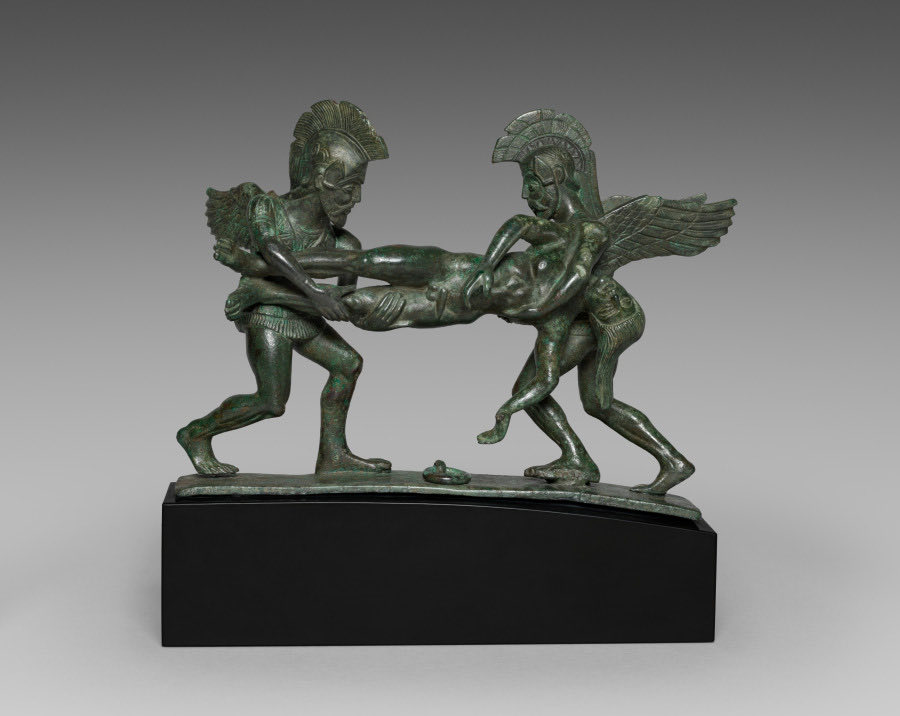
The Etruscans dominated central Italy from about 800 to 100 BCE, building cities such as Tarquinia, Cerveteri and Vulci, trading with Greece and the East, and eventually absorbed by Rome. Their painted chamber tombs and rich burials have supplied the antiquities market since the eighteenth century. Collectors hold bucchero vessels, bronze mirrors, votive bronze figurines, gold jewellery, terracotta antefixes and Etruscan-made Greek-style pottery; large bronzes and painted sarcophagi are museum objects.
| Dates | 800–100 BCE |
|---|---|
| Period | Iron Age |
| Region | Europe — Mediterranean |
| Areas | Etruria, Central Italy |
| Typical objects | Vessel, Mirror, Figurine, Brooch |
| Typical materials | Terracotta, Bronze, Gold |
Identification
Bucchero, the glossy black reduction-fired ware with thin walls early and heavy relief later, is uniquely Etruscan. Engraved bronze mirrors with mythological scenes and inscriptions, elongated votive bronze figures, granulated gold jewellery, and terracotta architectural sculpture are the other signature categories. Alphabetic inscriptions run right to left.
Legality
Etruscan objects are Italian state property under the Cultural Heritage Code and the 1939 law, export requires licences that are rarely granted, and the CPIA agreement between the US and Italy restricts imports. Many famous Etruscan objects have been repatriated from museums after tombaroli looting, so provenance research is mandatory.
Reproductions and fakes
Etruscan bronze mirrors are faked with modern engraving on ancient blank discs, and bucchero is forged in modern kilns; fakes lack the friable grey core and the wear on the foot. Gold jewellery in Etruscan style was made by Castellani and other nineteenth-century revivalists and is sometimes passed off as ancient. Votive bronzes with uniform green paint patina are modern.
Photographs
Elsewhere
- Wikidata: Q17161
- Wikipedia: Etruscans
Cite this article
Stratum Strata. "Etruscan" (Culture). Stratum Strata pack 2026.09, as of 2026-09-21. https://stratum.black/strata/cultures/etruscan. Accessed 2026-09-21.
@misc{stratum-etruscan,
  title        = {Etruscan},
  author       = {{Stratum Strata}},
  howpublished = {\url{https://stratum.black/strata/cultures/etruscan}},
  year         = {2026},
  note         = {Culture article, Stratum Strata pack 2026.09, as of 2026-09-21; sources: stratum, wikidata, commons, cleveland. Accessed 2026-09-21.}
}
Citations carry the pack version and the article's as-of date so they resolve to the same text later. The facts themselves belong to the sources listed below; cite those for the science.