
Culture · Chalcolithic
Bell Beaker
2800–1800 BCE, Europe — Western & Central
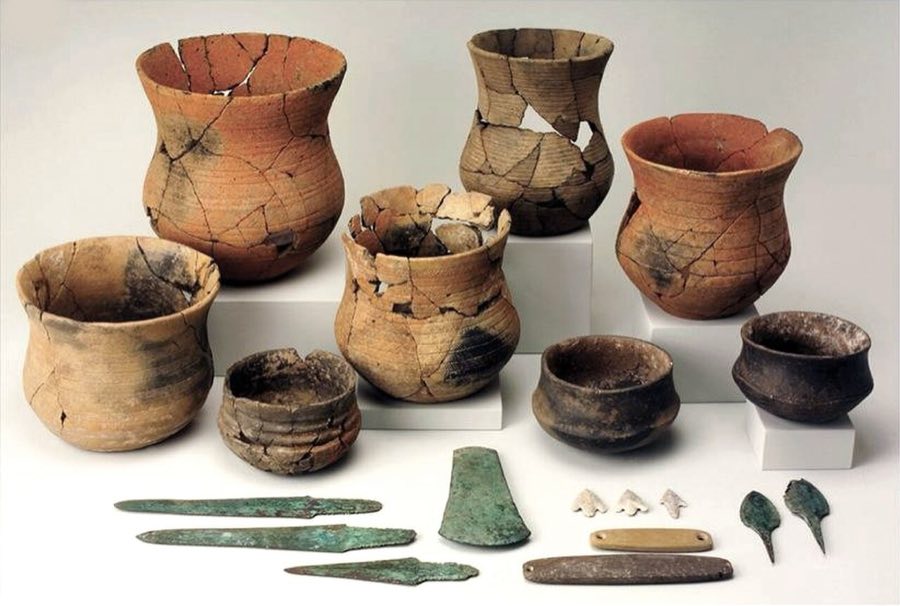
The Bell Beaker phenomenon spread across western and central Europe between about 2,800 and 1,800 BCE, carrying a distinctive drinking-cup, copper daggers, archery equipment and gold ornaments, and, in Britain, a new population. Beakers are found in single graves under round barrows from Iberia to Hungary and Britain. Collectors hold barbed-and-tanged arrowheads, stone wristguards, flint daggers, sherds and occasionally complete beakers, most from old barrow excavations.
| Dates | 2800–1800 BCE |
|---|---|
| Period | Chalcolithic |
| Region | Europe — Western & Central |
| Areas | Iberia, Britain, Central Europe, Low Countries |
| Typical objects | Vessel, Projectile point, Axe head, Dagger |
| Typical materials | Terracotta, Flint, Native copper, Gold |
Identification
The beaker itself is an inverted-bell cup with zoned comb- or cord-impressed decoration, often white-filled; regional styles vary from All-Over-Cord to Wessex/Middle Rhine. Barbed-and-tanged arrowheads, polished stone wristguards with two or four holes, tanged copper daggers, V-perforated buttons and gold basket earrings make up the typical grave set. Bronze appears only at the end.
Legality
In Britain, Beaker finds from private land are recorded through the Portable Antiquities Scheme and gold or silver objects fall under the Treasure Act; on the Continent finds are state property in most countries and grave groups are protected. Complete beakers on the market usually come from nineteenth-century barrow diggings with paper trails that must be checked.
Reproductions and fakes
Barbed-and-tanged arrowheads are the most commonly reproduced Beaker object, and modern knappers produce very fine examples; look for fresh edges, absence of patina and overly symmetrical barbs. Wristguards are made from modern slate and polished. Complete beakers are reconstructed from sherds with extensive filler and repainting of the zones.
Photographs
Elsewhere
- Wikidata: Q470867
- Wikipedia: Bell beaker culture
Cite this article
Stratum Strata. "Bell Beaker" (Culture). Stratum Strata pack 2026.09, as of 2026-09-21. https://stratum.black/strata/cultures/bell-beaker. Accessed 2026-09-21.
@misc{stratum-bell-beaker,
  title        = {Bell Beaker},
  author       = {{Stratum Strata}},
  howpublished = {\url{https://stratum.black/strata/cultures/bell-beaker}},
  year         = {2026},
  note         = {Culture article, Stratum Strata pack 2026.09, as of 2026-09-21; sources: stratum, wikidata, commons, cleveland. Accessed 2026-09-21.}
}
Citations carry the pack version and the article's as-of date so they resolve to the same text later. The facts themselves belong to the sources listed below; cite those for the science.