
Material · organic
Native copper
North America — Eastern Woodlands, North America — Arctic & Subarctic, Europe — Western & Central
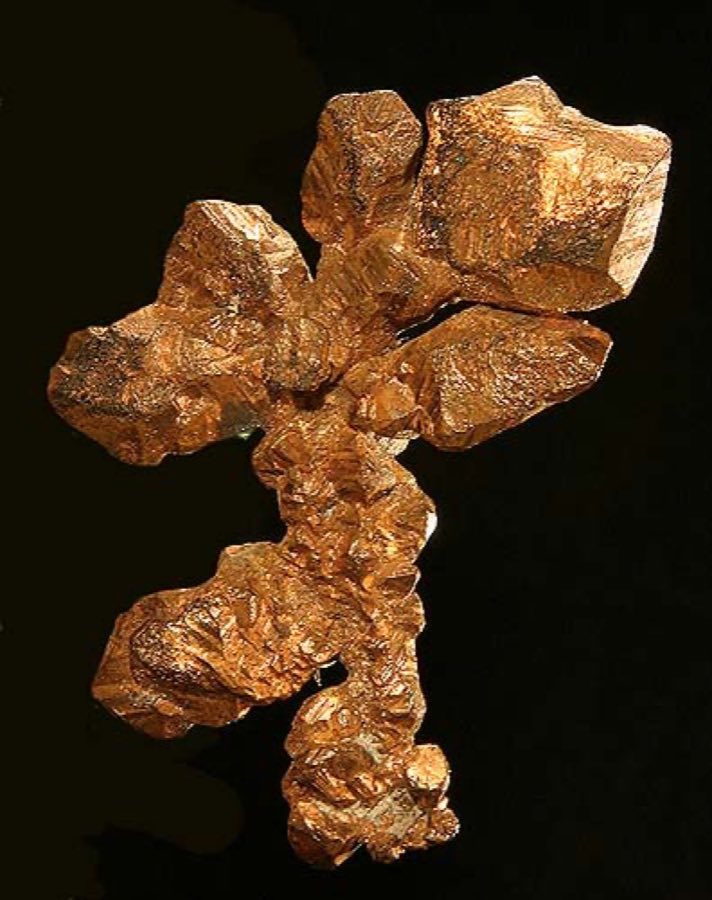
Native copper is unsmelted metallic copper, mined from the Keweenaw Peninsula and Isle Royale in Lake Superior from about 5,000 BCE and hammered cold into Old Copper tools and Hopewell and Mississippian ornaments; it was also used in the Arctic from the Coppermine River and in Chalcolithic Europe. It was worked without casting. Copper artifacts are rare and valuable.
| Kind | organic |
|---|---|
| Regions | North America — Eastern Woodlands, North America — Arctic & Subarctic, Europe — Western & Central |
Sources
The Keweenaw Peninsula and Isle Royale in Michigan hold thousands of ancient pits; float copper occurs in glacial drift across Wisconsin, Illinois and Ohio; the Coppermine River supplied the Copper Inuit; European sources include the Balkans and Alps. The Lake Superior deposits are the only place in the world where native copper occurs in such quantity and purity.
Identification
Native copper shows hammer facets and folds, often silver inclusions from Lake Superior deposits, and a green and brown mineral patina with cuprite beneath; modern refined copper lacks silver and trace elements. Annealing produces a coarse grain visible in section.
Substitutes and fakes
Old Copper reproductions from modern copper stock are widespread; look for uniform sheet thickness, fumed patina and no silver. Trace-element analysis is decisive.
Elsewhere
- Wikidata: Q583353
- Wikipedia: native copper
Cite this article
Stratum Strata. "Native copper" (Material). Stratum Strata pack 2026.09, as of 2026-09-21. https://stratum.black/strata/materials/native-copper. Accessed 2026-09-21.
@misc{stratum-native-copper,
  title        = {Native copper},
  author       = {{Stratum Strata}},
  howpublished = {\url{https://stratum.black/strata/materials/native-copper}},
  year         = {2026},
  note         = {Material article, Stratum Strata pack 2026.09, as of 2026-09-21; sources: stratum, wikidata, commons. Accessed 2026-09-21.}
}
Citations carry the pack version and the article's as-of date so they resolve to the same text later. The facts themselves belong to the sources listed below; cite those for the science.