
Culture · Chalcolithic
Cucuteni–Trypillia
4800–3000 BCE, Europe — Western & Central
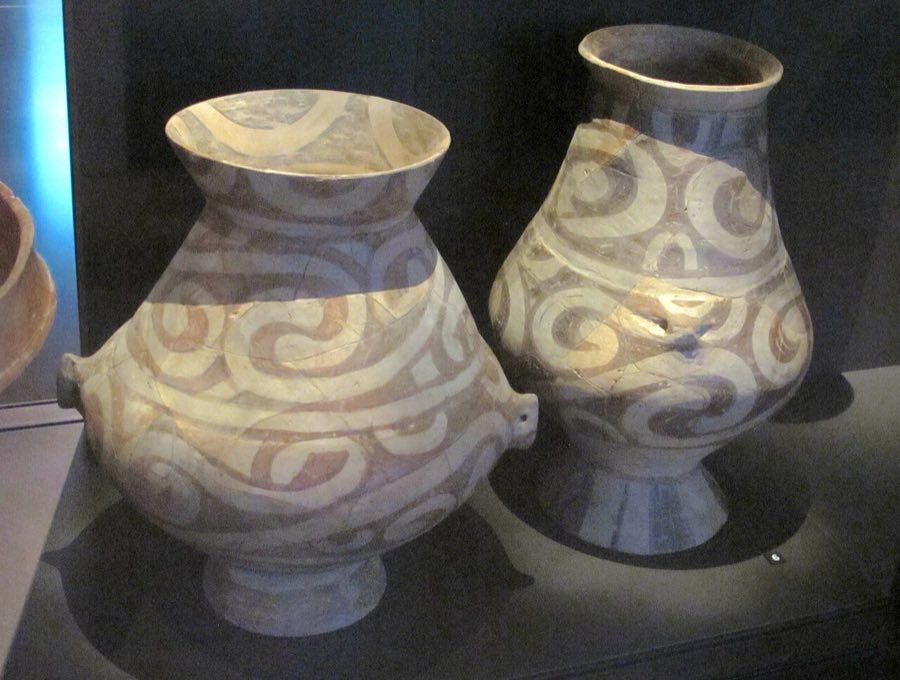
Cucuteni–Trypillia flourished between the Carpathians and the Dnieper from about 4800 to 3000 BCE, named after Cucuteni in Romanian Moldavia and Trypillia near Kyiv. Its later phases built the largest settlements of Neolithic Europe, the 'mega-sites' of Maidanetske, Talianki and Nebelivka with thousands of houses in concentric rings, which were periodically burned. The culture is renowned for its painted pottery in white, red and black spirals and its schematic female figurines with incised or painted decoration, as well as early copper tools. It ends with the transition to the steppe-influenced Usatove and Yamnaya horizons.
| Dates | 4800–3000 BCE |
|---|---|
| Period | Chalcolithic |
| Region | Europe — Western & Central |
| Areas | Moldova, Romania (Moldavia), Ukraine (west and central) |
| Typical objects | Vessel, Bowl, Figurine, Axe head, Blade |
| Typical materials | Terracotta, Flint, Native copper |
Identification
Cucuteni A pottery is incised and white-filled; Cucuteni A-B and B are polychrome painted with spirals, ovals and animal motifs on a fine buff fabric. Figurines are flat and elongated with a pinched head and wide hips, often perforated; Vinča figurines are stockier with triangular faces. Binocular-shaped vessels and painted 'ladles' are unique to the culture.
Legality
Romania's Law 182/2000 requires classification and an export certificate for archaeological objects; Moldova's Law on the Protection of Cultural Heritage makes archaeological finds state property; Ukraine's Law on Protection of Cultural Heritage and Law on Export of Cultural Property prohibit export of archaeological objects and Ukraine has sought emergency import restrictions in the United States since 2022. Trypillia painted vessels have been widely looted from Ukrainian sites and are a red-flag category.
Reproductions and fakes
Painted vessels and figurines are reproduced in Ukraine and Romania, sometimes on genuine sherds; look for pigments that sit on the surface rather than fired in, an even fabric with no burial staining, and figurines with too-crisp incisions. Genuine paint is matte and worn on the high points.
Elsewhere
Cite this article
Stratum Strata. "Cucuteni–Trypillia" (Culture). Stratum Strata pack 2026.09, as of 2026-09-21. https://stratum.black/strata/cultures/cucutenitrypillia. Accessed 2026-09-21.
@misc{stratum-cucutenitrypillia,
  title        = {Cucuteni–Trypillia},
  author       = {{Stratum Strata}},
  howpublished = {\url{https://stratum.black/strata/cultures/cucutenitrypillia}},
  year         = {2026},
  note         = {Culture article, Stratum Strata pack 2026.09, as of 2026-09-21; sources: stratum, wikidata, commons. Accessed 2026-09-21.}
}
Citations carry the pack version and the article's as-of date so they resolve to the same text later. The facts themselves belong to the sources listed below; cite those for the science.