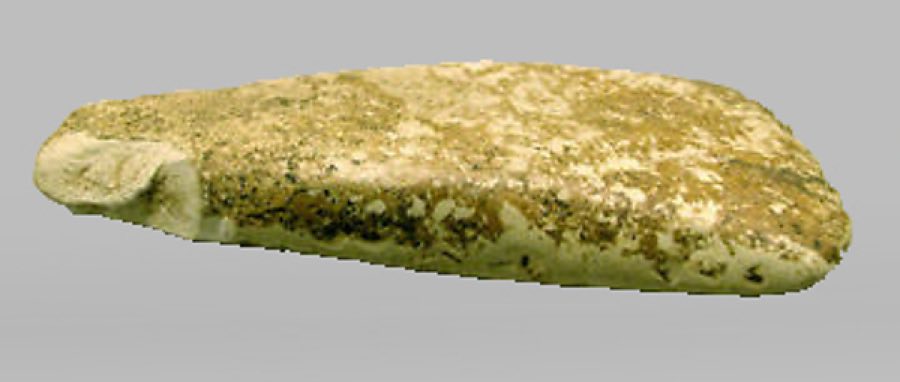
Celt · Neolithic
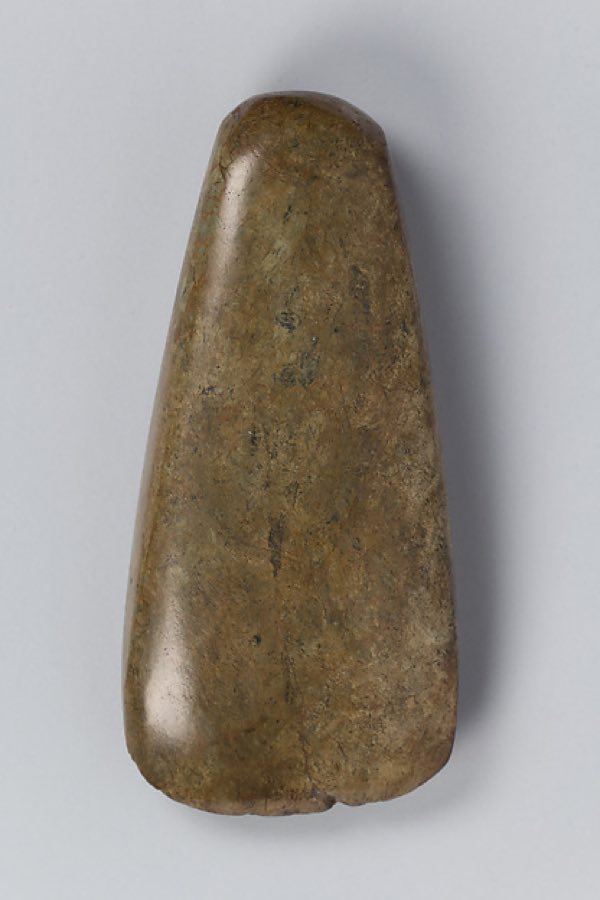
Polished stone axe
5500–2500 BCE, Linearbandkeramik
The polished stone axe is the woodworking tool of the European Neolithic, about 5,500 to 2,500 BCE, ground and polished from flint or fine-grained rock and hafted in a wooden sleeve. Axes travelled far from quarries such as Langdale, Plussulien and Rijckholt, and some were made in jadeitite for display. It is the commonest Neolithic find in Britain and Europe.
| Object | Celt |
|---|---|
| Dates | 5500–2500 BCE |
| Period | Neolithic |
| Cultures | Linearbandkeramik |
| Regions | Europe — Western & Central, Europe — Northern & British Isles, Europe — Mediterranean |
Diagnostic traits
Ground and polished axe head of flint or fine-grained rock with an oval or rectangular section; petrological groups identify quarries.
Identification
Neolithic axes are ground over the whole surface with an oval or rectangular section and a symmetrical bit, unlike Bronze Age flat axes in metal and unlike American celts, which are often only partly ground. Petrological groups identify sources. Flint axes may retain flake scars under the polish.
Reproductions and fakes
Reproduced on power grinders with parallel striations and no differential patina; genuine axes show hand-polish facets and edge damage. Jadeitite axes are faked in modern jade.
Photographs
Elsewhere
- met: 257672
Cite this article
Stratum Strata. "Polished stone axe" (Artifact type). Stratum Strata pack 2026.09, as of 2026-09-21. https://stratum.black/strata/types/polished-stone-axe. Accessed 2026-09-21.
@misc{stratum-polished-stone-axe,
  title        = {Polished stone axe},
  author       = {{Stratum Strata}},
  howpublished = {\url{https://stratum.black/strata/types/polished-stone-axe}},
  year         = {2026},
  note         = {Artifact type article, Stratum Strata pack 2026.09, as of 2026-09-21; sources: stratum, met. Accessed 2026-09-21.}
}
Citations carry the pack version and the article's as-of date so they resolve to the same text later. The facts themselves belong to the sources listed below; cite those for the science.