
Culture · Neolithic
Funnelbeaker
4100–2800 BCE, Europe — Northern & British Isles
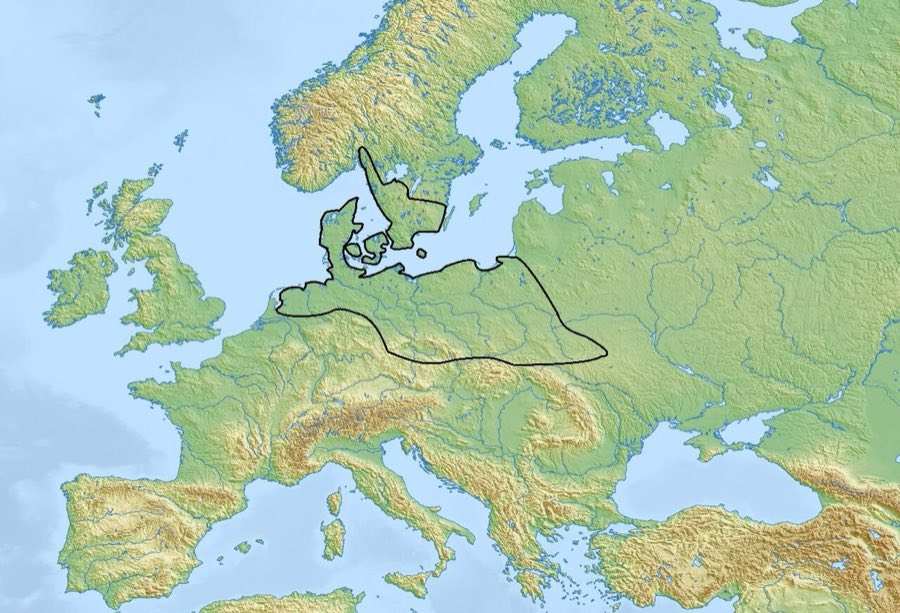
The Funnelbeaker (TRB) culture brought farming to the north European plain and Scandinavia from about 4100 BCE, spreading from the Elbe to the Vistula and north into Denmark and southern Sweden. It is defined by its funnel-necked beakers, collared flasks and amphorae, by thin-butted polished flint axes from the Danish flint mines, and by the megalithic dolmens and passage graves built across Denmark and northern Germany. Its later phases show heavy use of cattle, ards and wheeled vehicles, and it gives way to the Corded Ware and Single Grave cultures around 2800 BCE.
| Dates | 4100–2800 BCE |
|---|---|
| Period | Neolithic |
| Region | Europe — Northern & British Isles |
| Areas | Denmark, Southern Sweden, Northern Germany, Poland, Netherlands |
| Typical objects | Vessel, Axe head, Projectile point, Blade, Amphora |
| Typical materials | Flint, Terracotta |
Identification
TRB pottery has a funnel-shaped neck, and Middle Neolithic wares carry incised and stab-and-drag decoration in rich zones; Corded Ware beakers have cord impressions and a different profile. Thin-butted and later thick-butted polished flint axes with a rectangular section are the diagnostic tool; Ertebølle axes are flaked, not ground. Battle-axes appear only at the very end.
Legality
In Denmark the danefæ rules of the Museum Act make significant finds state property, and export of archaeological objects requires a permit; Sweden's Heritage Conservation Act (Kulturmiljölagen) protects ancient monuments and finds; Germany's Länder monument laws and the 2016 Cultural Property Protection Act (Kulturgutschutzgesetz) govern finds and export; Poland's Act on the Protection of Monuments makes all archaeological finds state property. Old collections with pre-1970 documentation are the lawful source.
Reproductions and fakes
Polished flint axes are reproduced from modern flint with a machine polish that is too even and lacks the striations of hand grinding; genuine pieces show wear at the edge and a matte patina on the polished faces. Pottery is rarely faked but is often over-restored.
Elsewhere
- Wikidata: Q875115
- Wikipedia: Funnelbeaker culture
Cite this article
Stratum Strata. "Funnelbeaker" (Culture). Stratum Strata pack 2026.09, as of 2026-09-21. https://stratum.black/strata/cultures/funnelbeaker. Accessed 2026-09-21.
@misc{stratum-funnelbeaker,
  title        = {Funnelbeaker},
  author       = {{Stratum Strata}},
  howpublished = {\url{https://stratum.black/strata/cultures/funnelbeaker}},
  year         = {2026},
  note         = {Culture article, Stratum Strata pack 2026.09, as of 2026-09-21; sources: stratum, wikidata, commons. Accessed 2026-09-21.}
}
Citations carry the pack version and the article's as-of date so they resolve to the same text later. The facts themselves belong to the sources listed below; cite those for the science.