
Culture · Neolithic
Vinča
5400–4500 BCE, Europe — Western & Central
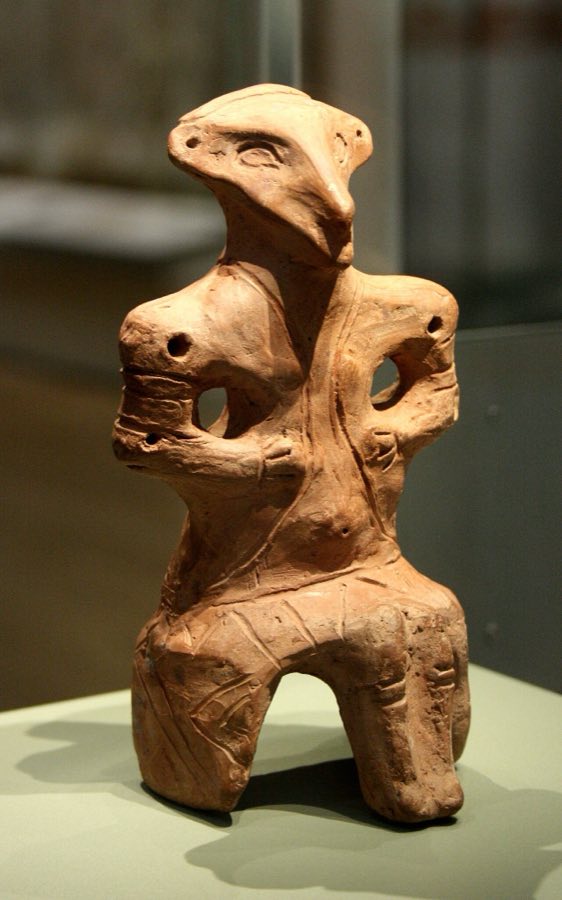
Vinča is the great Late Neolithic culture of the central Balkans, named after the tell of Vinča-Belo Brdo on the Danube near Belgrade and dated to about 5400–4500 BCE. Its settlements were large and long-lived, with rectangular houses, early copper mining at Rudna Glava and the world's earliest evidence of copper smelting at Belovode and Pločnik. Vinča is famous for its thousands of clay figurines with flat, mask-like triangular faces and for the incised 'Vinča signs' on pottery and figurines. Fine burnished black and grey pottery with channelled decoration is characteristic.
| Dates | 5400–4500 BCE |
|---|---|
| Period | Neolithic |
| Region | Europe — Western & Central |
| Areas | Serbia, Romania, Bulgaria, Bosnia, Kosovo, North Macedonia |
| Typical objects | Figurine, Vessel, Bowl, Axe head, Blade |
| Typical materials | Terracotta, Flint, Obsidian, Greenstone |
Identification
Vinča figurines have a flat triangular or pentagonal head with slit or large almond eyes and often a seated or standing pose with stump arms; Cucuteni figurines are elongated and incised, and Starčevo figurines cruder. Pottery is dark burnished with fluted or channelled ornament rather than painted, unlike Cucuteni-Trypillia.
Legality
Serbia's Law on Cultural Heritage makes archaeological finds state property and requires permits for any export; Romania's Law 182/2000 on the protection of movable cultural heritage classifies archaeological objects and prohibits their export without certificate; Bulgaria's Cultural Heritage Act (2009) declares all archaeological objects state property and criminalises trade without registration. Bulgaria is a CPIA designated country for the United States (since 2014), so import of Vinča material needs export documentation.
Reproductions and fakes
Vinča figurines are heavily forged in Serbia and Romania and sold online with invented findspots; fakes have sharp, fresh incisions, uniformly grey fabric and a surface that lacks the soft weathering and calcareous crust of tell burial. Thermoluminescence and comparison with excavated corpora are the checks.
Elsewhere
- Wikidata: Q831336
- Wikipedia: Vinča culture
Cite this article
Stratum Strata. "Vinča" (Culture). Stratum Strata pack 2026.09, as of 2026-09-21. https://stratum.black/strata/cultures/vinca. Accessed 2026-09-21.
@misc{stratum-vinca,
  title        = {Vinča},
  author       = {{Stratum Strata}},
  howpublished = {\url{https://stratum.black/strata/cultures/vinca}},
  year         = {2026},
  note         = {Culture article, Stratum Strata pack 2026.09, as of 2026-09-21; sources: stratum, wikidata, commons. Accessed 2026-09-21.}
}
Citations carry the pack version and the article's as-of date so they resolve to the same text later. The facts themselves belong to the sources listed below; cite those for the science.