
Culture · Late Archaic
Old Copper
4000–1000 BCE, North America — Eastern Woodlands
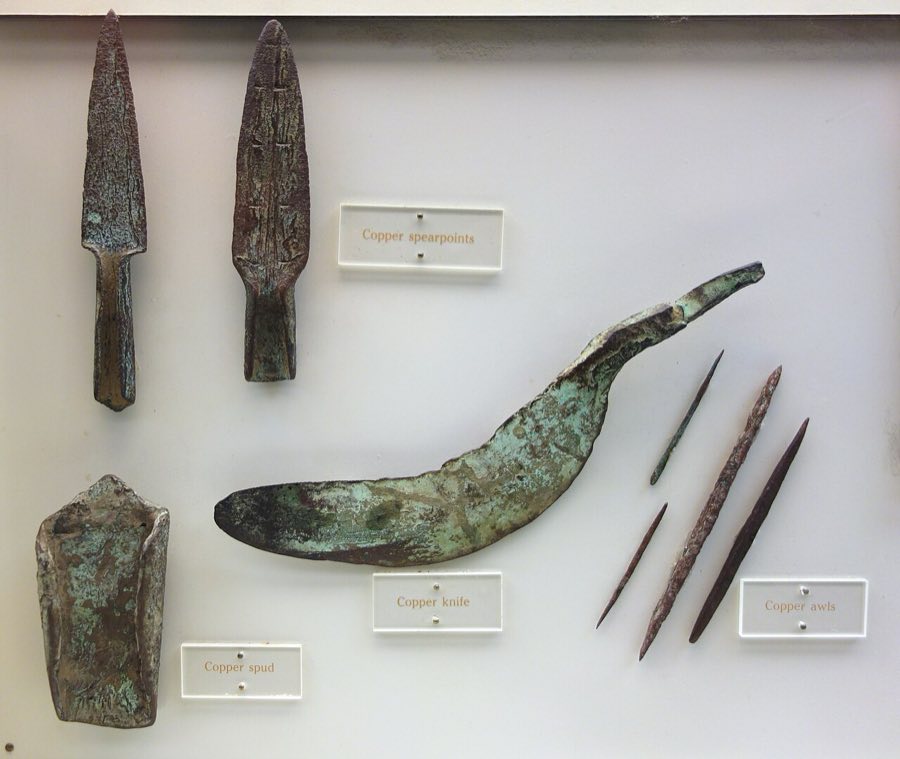
The Old Copper Complex describes Late Archaic peoples of the western Great Lakes who, between about 4,000 and 1,000 BCE, hammered native copper from the Lake Superior deposits into tools and ornaments. They worked the metal cold, annealing it to keep it workable, and never smelted or cast it. Collectors hold socketed and tanged spear points, knives, awls, celts, crescents, fish hooks and beads, most reported from Wisconsin, Michigan and Ontario.
| Dates | 4000–1000 BCE |
|---|---|
| Period | Late Archaic |
| Region | North America — Eastern Woodlands |
| Areas | Western Great Lakes, Wisconsin, Michigan, Ontario |
| Typical objects | Spearhead, Celt, Harpoon head, Bead |
| Typical materials | Native copper |
Identification
Genuine Old Copper tools show hammer facets, a folded conical socket or a drawn rat-tail tang, and a dark green or brown mineral patina with copper carbonate where it lay in soil. Silver inclusions from Lake Superior float copper are a good sign. Beads are rolled from thin sheet and points are often asymmetrical from hand-forging.
Legality
In the United States, prehistoric artifacts may be collected and sold only when they come from private land with the landowner's permission; removal from federal, tribal or most state land is prohibited under ARPA and state statutes. Funerary objects, human remains and sacred items are covered by NAGPRA and are not legitimately traded, and Canadian provinces treat archaeological finds as Crown or provincial property. The Oconto and Osceola cemetery sites were burial grounds, and copper objects with grave provenience are covered by NAGPRA.
Reproductions and fakes
Copper is easily worked, so modern reproductions hammered from modern copper stock are widespread and have been for over a century. Look for rolled-sheet stock with uniform thickness, a uniform chemical patina applied by ammonia fuming, and the absence of native silver. Spectrometry can separate Lake Superior native copper from refined modern copper by trace elements.
Elsewhere
- Wikidata: Q7083763
- Wikipedia: Old Copper Complex
Cite this article
Stratum Strata. "Old Copper" (Culture). Stratum Strata pack 2026.09, as of 2026-09-21. https://stratum.black/strata/cultures/old-copper. Accessed 2026-09-21.
@misc{stratum-old-copper,
  title        = {Old Copper},
  author       = {{Stratum Strata}},
  howpublished = {\url{https://stratum.black/strata/cultures/old-copper}},
  year         = {2026},
  note         = {Culture article, Stratum Strata pack 2026.09, as of 2026-09-21; sources: stratum, wikidata, commons. Accessed 2026-09-21.}
}
Citations carry the pack version and the article's as-of date so they resolve to the same text later. The facts themselves belong to the sources listed below; cite those for the science.