
Material · metal
Bronze
Europe — Western & Central, Europe — Mediterranean, Europe — Northern & British Isles, Near East & Mesopotamia, Egypt & Nile Valley, Central Asia & Steppe, East Asia, South America — Andes
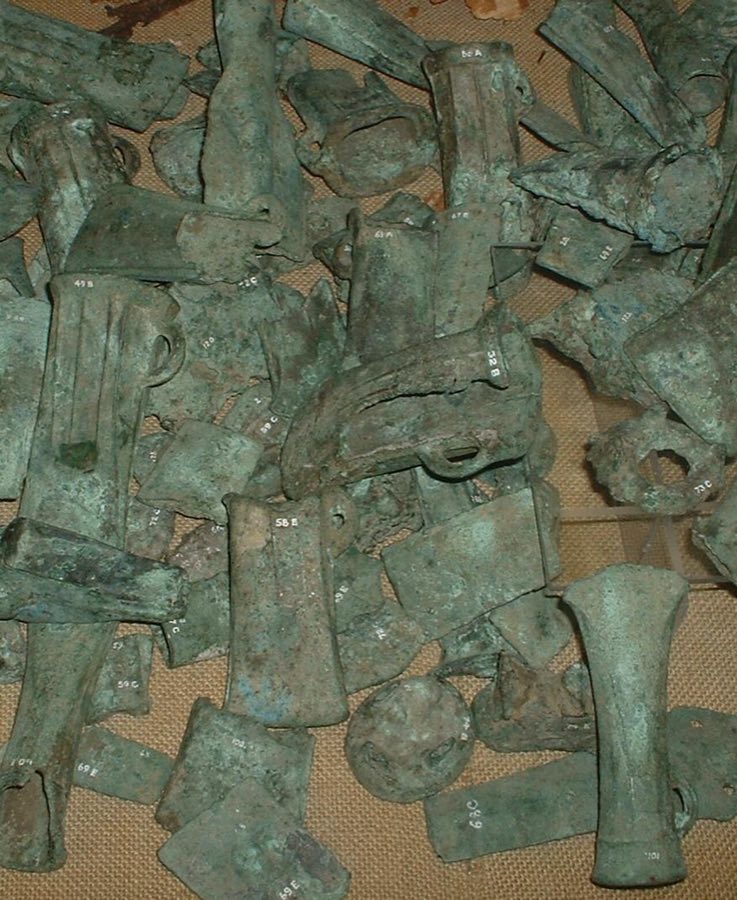
Bronze is copper alloyed with tin, and here also covers unspecified copper alloys including brass, used for tools, weapons, vessels, brooches and coins from the third millennium BCE across Europe, the Near East, Egypt, China and the Andes. The European Bronze Age, Chinese ritual bronzes and Roman brooches are all bronze. It is the most common ancient metal in collections.
| Kind | metal |
|---|---|
| Regions | Europe — Western & Central, Europe — Mediterranean, Europe — Northern & British Isles, Near East & Mesopotamia, Egypt & Nile Valley, Central Asia & Steppe, East Asia, South America — Andes |
Sources
Copper came from Cyprus, the Alps, Spain, Cornwall, Sinai, Anatolia and Oman; tin from Cornwall, Brittany, Iberia, Afghanistan and Southeast Asia; Chinese sources lie in the Yangtze basin. Lead isotope analysis of a bronze can sometimes identify the ore field that supplied its copper.
Identification
Bronze is golden to brown when fresh and develops green, blue, red and brown patinas of malachite, azurite and cuprite; genuine patina is hard, layered and integrated with the metal. Casting seams, hammering and wear indicate manufacture and use. XRF gives alloy composition.
Substitutes and fakes
Bronze objects are cast new from originals and patinated with chemicals; artificial patina is soft, uniform and paint-like, while genuine patina resists a fingernail and shows stratification. Modern alloys are revealed by XRF.
Elsewhere
- Wikidata: Q34095
- Wikipedia: bronze
Cite this article
Stratum Study. "Bronze" (Material). Stratum Study pack 2026.09, as of 2026-09-21. https://stratum.black/study/materials/bronze. Accessed 2026-09-21.
@misc{stratum-bronze,
  title        = {Bronze},
  author       = {{Stratum Study}},
  howpublished = {\url{https://stratum.black/study/materials/bronze}},
  year         = {2026},
  note         = {Material article, Stratum Study pack 2026.09, as of 2026-09-21; sources: stratum, wikidata, commons. Accessed 2026-09-21.}
}
Citations carry the pack version and the article's as-of date so they resolve to the same text later. The facts themselves belong to the sources listed below; cite those for the science.