
Material · lithic
Flint
Europe — Western & Central, Europe — Northern & British Isles, Near East & Mesopotamia, Egypt & Nile Valley
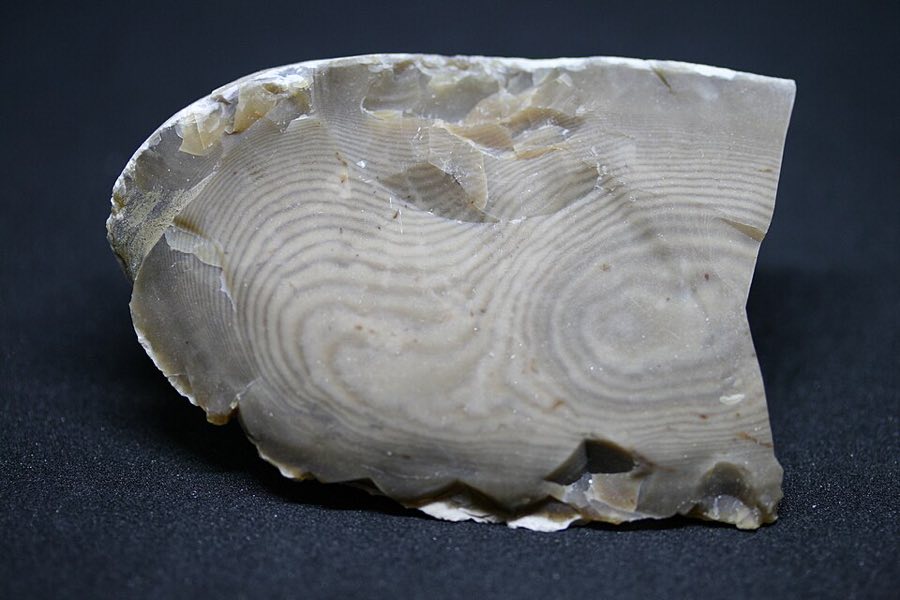
Flint is the nodular chert of the Cretaceous chalk of Britain, France, Denmark, Belgium and adjacent regions, the primary toolstone of Old World prehistory from the Palaeolithic to the Bronze Age. It was mined at Grimes Graves, Spiennes and Rijckholt for Neolithic axes. The term is also used for cherts in the Levant and Egypt.
| Kind | lithic |
|---|---|
| Regions | Europe — Western & Central, Europe — Northern & British Isles, Near East & Mesopotamia, Egypt & Nile Valley |
Sources
Flint occurs in the Upper Cretaceous chalk from southern England through northern France, Belgium and Denmark to Poland, and as derived gravels; Egyptian and Levantine flints come from Eocene and Cretaceous limestones. Beach and river gravels supplied much of the flint used at sites away from the chalk.
Identification
Fresh flint is black, grey or brown and glassy with a white cortex; buried pieces develop a white, blue or yellow patina and river gravel pieces are stained ochre. Fossils such as sponges and echinoids occur. Danish and Scandinavian flint is often grey and banded.
Substitutes and fakes
British and European flint reproductions of arrowheads, axes and handaxes are widespread and aged by tumbling and staining. Genuine pieces show patina consistent across all surfaces and sediment in flake scars.
Elsewhere
- Wikidata: Q83087
- Wikipedia: flint
Cite this article
Stratum Study. "Flint" (Material). Stratum Study pack 2026.09, as of 2026-09-21. https://stratum.black/study/materials/flint. Accessed 2026-09-21.
@misc{stratum-flint,
  title        = {Flint},
  author       = {{Stratum Study}},
  howpublished = {\url{https://stratum.black/study/materials/flint}},
  year         = {2026},
  note         = {Material article, Stratum Study pack 2026.09, as of 2026-09-21; sources: stratum, wikidata, commons. Accessed 2026-09-21.}
}
Citations carry the pack version and the article's as-of date so they resolve to the same text later. The facts themselves belong to the sources listed below; cite those for the science.