
Culture · Neolithic
Linearbandkeramik
5500–4500 BCE, Europe — Western & Central
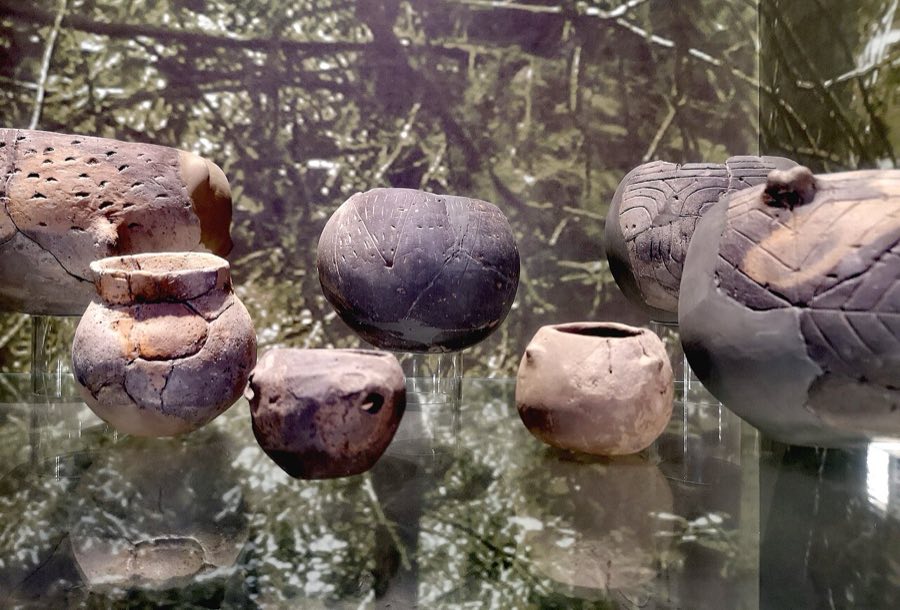
The Linearbandkeramik, or LBK, was the first farming culture of temperate Europe, spreading from Hungary to the Paris Basin between about 5,500 and 4,500 BCE. Its people built long timber houses in loess landscapes and made round-bottomed pottery incised with bands of lines. Collectors hold polished shoe-last adzes, flaked flint blades and sickle inserts, decorated sherds and Spondylus shell ornaments, mostly from German, Austrian and Czech sites and from old collections.
| Dates | 5500–4500 BCE |
|---|---|
| Period | Neolithic |
| Region | Europe — Western & Central |
| Areas | Central Europe, Danube Basin, Paris Basin |
| Typical objects | Adze, Vessel, Celt |
| Typical materials | Flint, Greenstone, Terracotta |
Identification
LBK pottery is fine, dark and burnished with curvilinear incised bands, spirals and meanders, sometimes punctuated; coarse ware has fingertip impressions. The shoe-last adze, a high-backed ground stone adze in amphibolite, is the diagnostic tool, alongside flat adzes and perforated adzes. Blades are long and regular, often in Rijckholt or Bavarian flint.
Legality
Germany, Austria, the Czech Republic, Poland, the Netherlands and France have state or Land ownership of archaeological finds with reporting duties, and export of significant pieces requires permits. Private holdings are typically old surface collections, and fieldwalking finds must be reported in most jurisdictions.
Reproductions and fakes
Shoe-last adzes are reproduced in modern amphibolite and ground on power wheels, leaving parallel striations and no differential polish. Decorated sherds are seldom faked but complete LBK vessels offered privately are rare enough to warrant suspicion of restoration from mixed sherds.
Elsewhere
- Wikidata: Q806348
- Wikipedia: Linear Pottery culture
Cite this article
Stratum Study. "Linearbandkeramik" (Culture). Stratum Study pack 2026.09, as of 2026-09-21. https://stratum.black/study/cultures/linearbandkeramik. Accessed 2026-09-21.
@misc{stratum-linearbandkeramik,
  title        = {Linearbandkeramik},
  author       = {{Stratum Study}},
  howpublished = {\url{https://stratum.black/study/cultures/linearbandkeramik}},
  year         = {2026},
  note         = {Culture article, Stratum Study pack 2026.09, as of 2026-09-21; sources: stratum, wikidata, commons. Accessed 2026-09-21.}
}
Citations carry the pack version and the article's as-of date so they resolve to the same text later. The facts themselves belong to the sources listed below; cite those for the science.