
Culture · Upper Palaeolithic
Aurignacian
43000–28000 BCE, Europe — Western & Central
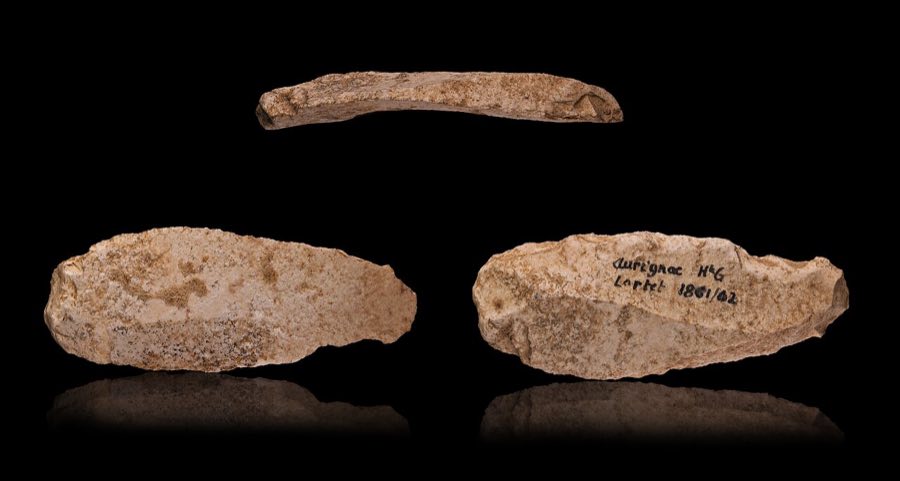
The Aurignacian is the first widespread Upper Palaeolithic culture of anatomically modern humans in Europe, from about 43,000 to 28,000 years ago. It brought blade technology, bone and antler points, personal ornaments and the earliest figurative art, including the Chauvet cave paintings and the Swabian ivory figurines. Collectors hold flint blades, carinated and nosed scrapers, Dufour bladelets and, rarely, antler points; the art is entirely in museums.
| Dates | 43000–28000 BCE |
|---|---|
| Period | Upper Palaeolithic |
| Region | Europe — Western & Central |
| Areas | Europe, Levant |
| Typical objects | Blade, Scraper, Projectile point, Bead |
| Typical materials | Flint, Bone and antler |
Identification
Aurignacian flintwork features thick carinated and nosed end scrapers, strangulated blades with heavy scalar retouch and small twisted Dufour bladelets. Split-based antler points and lozenge-shaped points mark the early and later phases. Pierced teeth, ivory beads and shell ornaments appear in graves and living floors.
Legality
Aurignacian material comes almost entirely from excavated cave and rock-shelter sites in France, Germany, Spain and central Europe where the state owns finds; legitimate private holdings are limited to old, documented collections. Britain has very little Aurignacian material.
Reproductions and fakes
Aurignacian bone and ivory art is forged, occasionally with great skill, and the Vogelherd and Hohle Fels finds have inspired modern carvings in mammoth ivory. Flint tools are less faked but are misattributed from later blade industries. Any figurine or decorated bone offered privately should be treated as modern.
Elsewhere
- Wikidata: Q221901
- Wikipedia: Aurignacian
Cite this article
Stratum Study. "Aurignacian" (Culture). Stratum Study pack 2026.09, as of 2026-09-21. https://stratum.black/study/cultures/aurignacian. Accessed 2026-09-21.
@misc{stratum-aurignacian,
  title        = {Aurignacian},
  author       = {{Stratum Study}},
  howpublished = {\url{https://stratum.black/study/cultures/aurignacian}},
  year         = {2026},
  note         = {Culture article, Stratum Study pack 2026.09, as of 2026-09-21; sources: stratum, wikidata, commons. Accessed 2026-09-21.}
}
Citations carry the pack version and the article's as-of date so they resolve to the same text later. The facts themselves belong to the sources listed below; cite those for the science.