
Culture · Mesolithic
Natufian
12500–9500 BCE, Near East & Mesopotamia
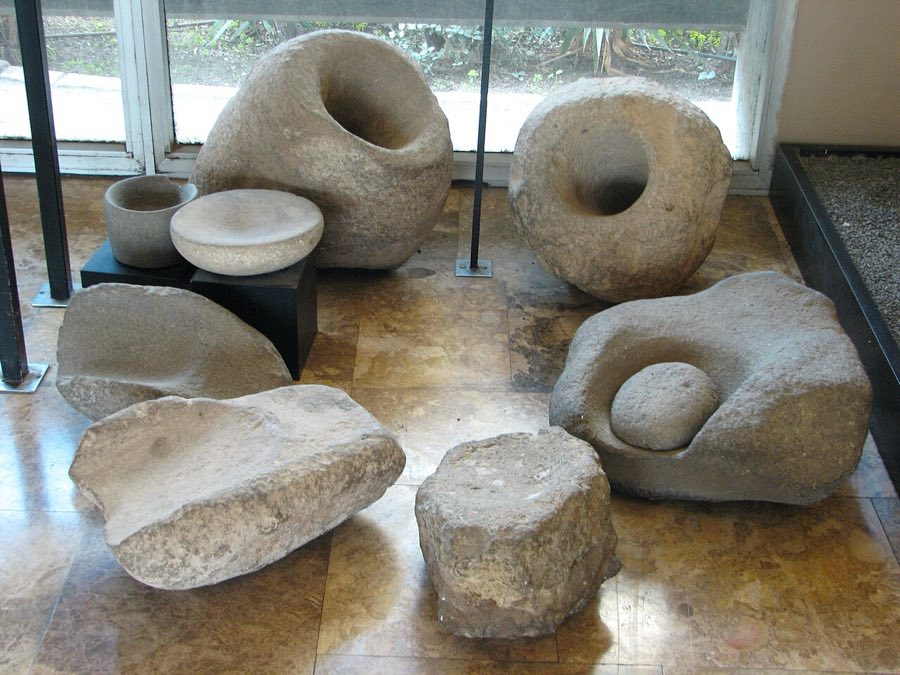
The Natufians were the sedentary hunter-gatherers of the Levant between about 12,500 and 9,500 BCE, immediately before the origins of farming. They lived in stone-built villages such as Ain Mallaha and Wadi Hammeh, harvested wild cereals with sickles and buried their dead with ornaments. Collectors rarely hold Natufian material, since it comes from excavated sites in Israel, Jordan, Lebanon and Syria, but lunates, sickle blades and basalt mortars appear in old collections.
| Dates | 12500–9500 BCE |
|---|---|
| Period | Mesolithic |
| Region | Near East & Mesopotamia |
| Areas | Levant |
| Typical objects | Microlith, Sickle blade, Bead |
| Typical materials | Flint, Bone and antler, Basalt |
Identification
The lunate, a crescent-shaped microlith with abrupt or bifacial Helwan retouch, is the type fossil, along with sickle blades bearing gloss, bone points and harpoons, and ground basalt mortars, pestles and bowls. Dentalium shell beads and carved bone with animal heads mark burials. Sites have stone-walled semi-subterranean houses.
Legality
Israel, Jordan, Lebanon and Syria all vest ownership of antiquities in the state and require export licences that are essentially never granted for excavated prehistoric material; Israel permits the trade of items from pre-1978 stock through licensed dealers only. Natufian material on the market is thus nearly always problematic.
Reproductions and fakes
Lunates and sickle blades are easily knapped and appear in bulk lots of 'Levantine microliths' of uncertain age. Basalt mortars are hard to distinguish from later Neolithic and Bronze Age pieces without context. Carved bone Natufian art is very rare and any privately offered example should be assumed modern.
Elsewhere
- Wikidata: Q733489
- Wikipedia: Natufian culture
Cite this article
Stratum Study. "Natufian" (Culture). Stratum Study pack 2026.09, as of 2026-09-21. https://stratum.black/study/cultures/natufian. Accessed 2026-09-21.
@misc{stratum-natufian,
  title        = {Natufian},
  author       = {{Stratum Study}},
  howpublished = {\url{https://stratum.black/study/cultures/natufian}},
  year         = {2026},
  note         = {Culture article, Stratum Study pack 2026.09, as of 2026-09-21; sources: stratum, wikidata, commons. Accessed 2026-09-21.}
}
Citations carry the pack version and the article's as-of date so they resolve to the same text later. The facts themselves belong to the sources listed below; cite those for the science.