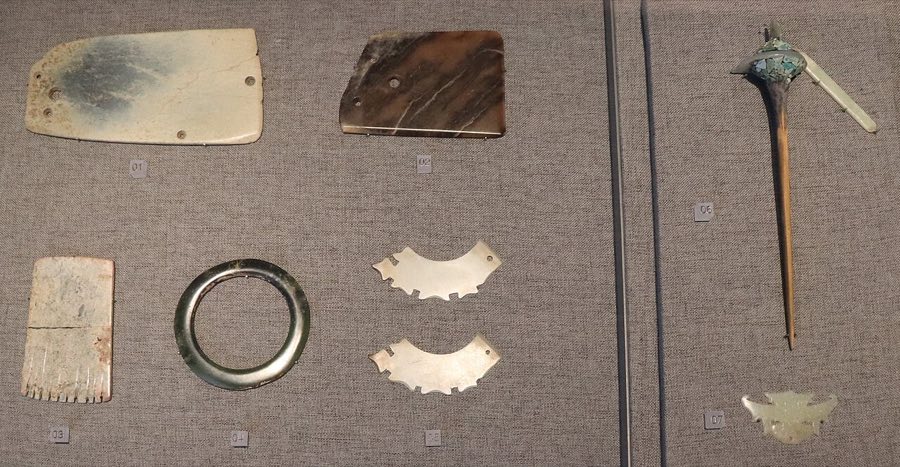

Material · lithic
Jade
Mesoamerica, East Asia
Jade covers jadeite, the hard green pyroxene of Mesoamerica and Burma, and nephrite, the tough amphibole of China, New Zealand and British Columbia; the Olmec and Maya carved jadeite celts and masks, and Chinese cultures carved nephrite from the Neolithic onward. Jade was the most valuable material in both worlds. Serpentine and other green stones are often sold as jade.
| Kind | lithic |
|---|---|
| Regions | Mesoamerica, East Asia |
Sources
Mesoamerican jadeite comes from the Motagua valley of Guatemala; Chinese nephrite from Khotan in Xinjiang and later from British Columbia; Burmese jadeite from Kachin state; New Zealand pounamu from the South Island. The Motagua source was lost to memory after the conquest and rediscovered only in the twentieth century.
Identification
Jadeite is granular and often blue-green or emerald with a glassy polish; nephrite is fibrous, waxy and pale to dark green or white. Both are extremely tough and cannot be scratched by steel. Serpentine and bowenite are softer and scratch easily.
Substitutes and fakes
Dyed and polymer-treated jadeite, serpentine, quartz and glass are sold as jade, and modern carvings in genuine jade are aged with acid and burial. Hardness tests, specific gravity and rotary-tool marks are the checks.
Cite this article
Stratum Strata. "Jade" (Material). Stratum Strata pack 2026.09, as of 2026-09-21. https://stratum.black/strata/materials/jade. Accessed 2026-09-21.
@misc{stratum-jade,
  title        = {Jade},
  author       = {{Stratum Strata}},
  howpublished = {\url{https://stratum.black/strata/materials/jade}},
  year         = {2026},
  note         = {Material article, Stratum Strata pack 2026.09, as of 2026-09-21; sources: stratum, commons. Accessed 2026-09-21.}
}
Citations carry the pack version and the article's as-of date so they resolve to the same text later. The facts themselves belong to the sources listed below; cite those for the science.