Culture · Jomon
Jomon
10500–300 BCE, East Asia
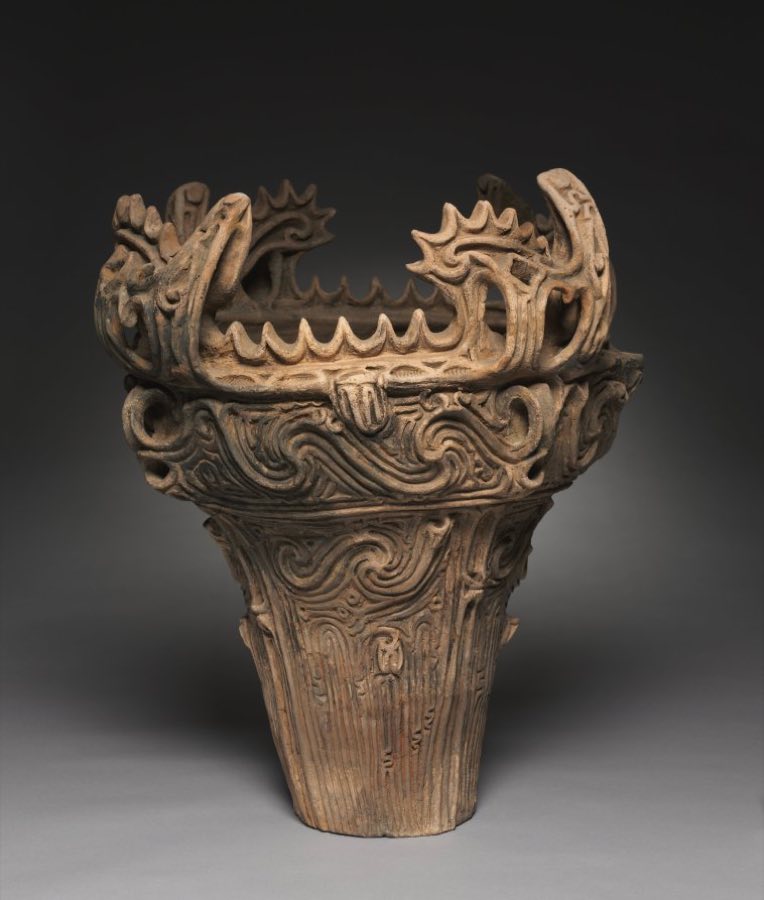
The Jomon is Japan's long hunter-gatherer-fisher period from the end of the Pleistocene, about 10,500 BCE, to the arrival of rice farming around 300 BCE, named for the cord-marked pottery that is among the world's earliest. Jomon people lived in pit-house villages, exploited nuts, shellfish and salmon, and produced ceramic dogu figurines with goggle eyes, stone rods, jade beads and lacquered wooden objects. The Middle Jomon of central Honshu is the artistic peak, with flame-rimmed vessels; the Late and Final Jomon of Tohoku produced the finest dogu and burnished pottery. Sannai-Maruyama in Aomori is the best-known excavated village.
| Dates | 10500–300 BCE |
|---|---|
| Period | Jomon |
| Region | East Asia |
| Areas | Japan (Honshu, Hokkaido, Kyushu), Tohoku, Kanto, Chubu |
| Typical objects | Jar, Vessel, Figurine, Projectile point, Bead, Pendant |
| Typical materials | Terracotta, Obsidian, Jade, Bone and antler |
Identification
Cord-marked, hand-built low-fired pottery with pointed or flat bases; dogu figurines with hollow bodies, large eyes and stylised limbs; obsidian arrowheads with concave bases and stone 'sekibo' rods. Yayoi pottery is thinner and plainer, and Yayoi bronze bells and mirrors are absent from Jomon contexts.
Legality
Japan's Law for the Protection of Cultural Properties (1950) treats excavated objects as buried cultural property that must be reported and become state or prefectural property if unclaimed, and prohibits export of designated Important Cultural Properties and National Treasures. Ordinary Jomon sherds and figurines are not banned from export but need documentation; there is no CPIA agreement with the United States.
Reproductions and fakes
Dogu are reproduced widely as souvenirs and a few are aged and sold as authentic; restored vessels made up of unrelated sherds are the commoner problem. Genuine Jomon pottery is soft, blackened and porous with a low-fired fabric.
Elsewhere
- Wikidata: Q52824
- Wikipedia: Jōmon period
Cite this article
Stratum Strata. "Jomon" (Culture). Stratum Strata pack 2026.09, as of 2026-09-21. https://stratum.black/strata/cultures/jomon. Accessed 2026-09-21.
@misc{stratum-jomon,
  title        = {Jomon},
  author       = {{Stratum Strata}},
  howpublished = {\url{https://stratum.black/strata/cultures/jomon}},
  year         = {2026},
  note         = {Culture article, Stratum Strata pack 2026.09, as of 2026-09-21; sources: stratum, wikidata, cleveland. Accessed 2026-09-21.}
}
Citations carry the pack version and the article's as-of date so they resolve to the same text later. The facts themselves belong to the sources listed below; cite those for the science.