Culture · Middle Woodland
Woodland (Eastern)
1000 BCE–1000 CE, North America — Eastern Woodlands
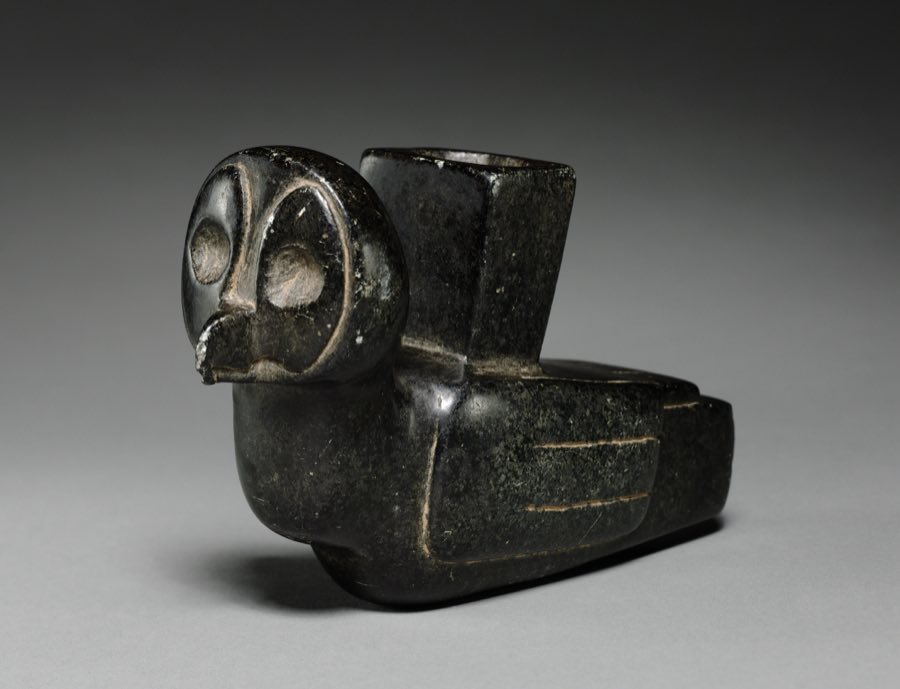
Woodland is a generic label for eastern North American sites from about 1,000 BCE to 1,000 CE that are not assigned to Adena, Hopewell or a named local phase. It is the era of the first pottery, the spread of small-scale gardening, mound building and, after 500 CE, the bow and arrow. Collectors hold cordmarked jars and sherds, stemmed and notched points, Late Woodland triangular arrowpoints, celts, pipes and slate gorgets from across the East.
| Dates | 1000 BCE–1000 CE |
|---|---|
| Period | Middle Woodland |
| Region | North America — Eastern Woodlands |
| Areas | Eastern United States, Southern Ontario |
| Typical objects | Projectile point, Jar, Celt, Gorget, Pipe |
| Typical materials | Grog-tempered earthenware, Chert, Greenstone, Banded slate |
Identification
Woodland pottery is conoidal and cordmarked or fabric-impressed, grit- or grog-tempered, and often the only diagnostic find at a site. Point types include Steuben, Lowe and Chesser expanded-stem forms and, later, Jack's Reef pentagonals and Levanna triangles. Polished celts replace grooved axes and elbow pipes appear late in the period.
Legality
In the United States, prehistoric artifacts may be collected and sold only when they come from private land with the landowner's permission; removal from federal, tribal or most state land is prohibited under ARPA and state statutes. Funerary objects, human remains and sacred items are covered by NAGPRA and are not legitimately traded, and Canadian provinces treat archaeological finds as Crown or provincial property. Woodland burial mounds are numerous and protected under state cemetery laws in addition to NAGPRA.
Reproductions and fakes
Fakes are less of a problem than for Archaic or Hopewell material, but Jack's Reef points are reproduced because of their fine flaking and triangles are easily made from small flakes. Whole cordmarked pots are rare and usually come from graves, so intact vessels deserve scrutiny of both authenticity and provenance.
Cite this article
Stratum Study. "Woodland (Eastern)" (Culture). Stratum Study pack 2026.09, as of 2026-09-21. https://stratum.black/study/cultures/woodland-eastern. Accessed 2026-09-21.
@misc{stratum-woodland-eastern,
  title        = {Woodland (Eastern)},
  author       = {{Stratum Study}},
  howpublished = {\url{https://stratum.black/study/cultures/woodland-eastern}},
  year         = {2026},
  note         = {Culture article, Stratum Study pack 2026.09, as of 2026-09-21; sources: stratum, cleveland. Accessed 2026-09-21.}
}
Citations carry the pack version and the article's as-of date so they resolve to the same text later. The facts themselves belong to the sources listed below; cite those for the science.