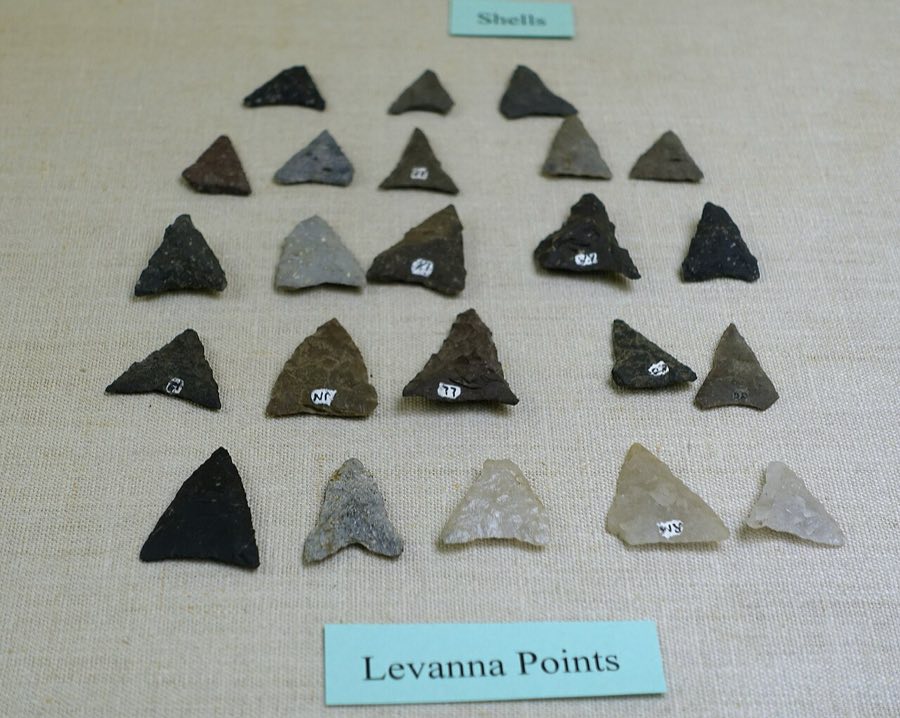

Projectile point · Late Woodland
Levanna
700–1350 CE, Woodland (Eastern)
The Levanna point is the broad triangular arrowpoint of the Late Woodland Northeast, about 700 to 1,350 CE, named after a site in New York. It armed the earliest bows in the region and is found in enormous numbers. Madison replaces it in later Iroquoian sites.
| Object | Projectile point |
|---|---|
| Dates | 700–1350 CE |
| Period | Late Woodland |
| Cultures | Woodland (Eastern) |
| Regions | North America — Eastern Woodlands |
Diagnostic traits
Broad, thin equilateral triangle with a concave base; width often equal to length.
Identification
Levanna is a broad, thin equilateral triangle with a concave base, often as wide as it is long, unlike Madison, which is narrower and isosceles, and Jack's Reef, which is pentagonal or notched. Edges are straight. Size is small to medium.
Reproductions and fakes
Small triangles are easy to knap and appear in bulk lots; genuine pieces show basal thinning and patina. Values are low so fakes are rare.
Elsewhere
- Wikidata: Q138717656
Cite this article
Stratum Study. "Levanna" (Artifact type). Stratum Study pack 2026.09, as of 2026-09-21. https://stratum.black/study/types/levanna. Accessed 2026-09-21.
@misc{stratum-levanna,
  title        = {Levanna},
  author       = {{Stratum Study}},
  howpublished = {\url{https://stratum.black/study/types/levanna}},
  year         = {2026},
  note         = {Artifact type article, Stratum Study pack 2026.09, as of 2026-09-21; sources: stratum, wikidata, commons. Accessed 2026-09-21.}
}
Citations carry the pack version and the article's as-of date so they resolve to the same text later. The facts themselves belong to the sources listed below; cite those for the science.