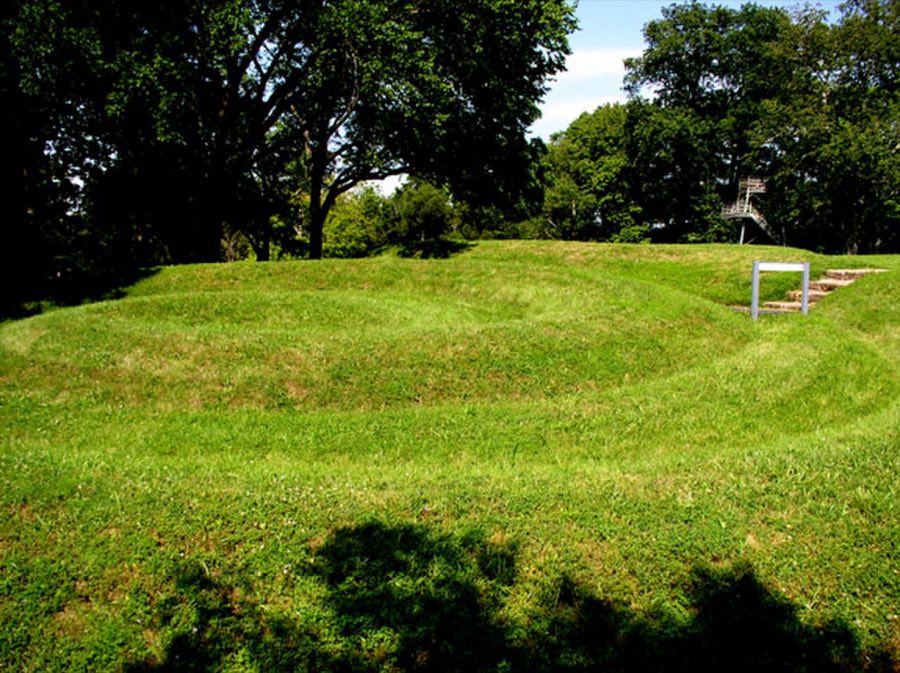

Culture · Late Prehistoric
Fort Ancient
1000–1750 CE, North America — Eastern Woodlands
Fort Ancient is the maize-farming culture of the middle Ohio Valley from about 1,000 to 1,750 CE, contemporary with Mississippian but distinct from it in pottery and settlement. Its people lived in circular villages around plazas and are considered ancestral to the Shawnee and related groups. Collectors hold triangular arrowpoints, shell-tempered jars with strap handles, elbow pipes, discoidals, bone tools and marine-shell gorgets, mostly from Ohio, Kentucky and Indiana.
| Dates | 1000–1750 CE |
|---|---|
| Period | Late Prehistoric |
| Region | North America — Eastern Woodlands |
| Areas | Ohio Valley, Kentucky, Indiana, West Virginia |
| Typical objects | Projectile point, Jar, Pipe, Discoidal, Celt |
| Typical materials | Shell-tempered earthenware, Flint Ridge flint, Upper Mercer chert, Marine shell |
Identification
Fort Ancient pottery is shell-tempered with strap handles, guilloche incising on jar necks and, late, a smoothed cordmarked surface. Madison and Fort Ancient triangular points, small sandstone discoidals, elbow pipes and bone beamers are common. Late sites yield European trade brass and glass beads.
Legality
In the United States, prehistoric artifacts may be collected and sold only when they come from private land with the landowner's permission; removal from federal, tribal or most state land is prohibited under ARPA and state statutes. Funerary objects, human remains and sacred items are covered by NAGPRA and are not legitimately traded, and Canadian provinces treat archaeological finds as Crown or provincial property. Fort Ancient village sites include cemeteries, and the Fort Ancient earthworks in Ohio (actually Hopewell) are a state memorial where collecting is prohibited.
Reproductions and fakes
Fort Ancient material is rarely faked, though shell gorgets and effigy pipes attributed to the culture can be modern. Complete jars are sometimes reassembled from unrelated sherds and heavily restored with filler painted to look like shell-tempered paste.
Elsewhere
- Wikidata: Q2040969
- Wikipedia: Fort Ancient
Cite this article
Stratum Strata. "Fort Ancient" (Culture). Stratum Strata pack 2026.09, as of 2026-09-21. https://stratum.black/strata/cultures/fort-ancient. Accessed 2026-09-21.
@misc{stratum-fort-ancient,
  title        = {Fort Ancient},
  author       = {{Stratum Strata}},
  howpublished = {\url{https://stratum.black/strata/cultures/fort-ancient}},
  year         = {2026},
  note         = {Culture article, Stratum Strata pack 2026.09, as of 2026-09-21; sources: stratum, wikidata, commons. Accessed 2026-09-21.}
}
Citations carry the pack version and the article's as-of date so they resolve to the same text later. The facts themselves belong to the sources listed below; cite those for the science.