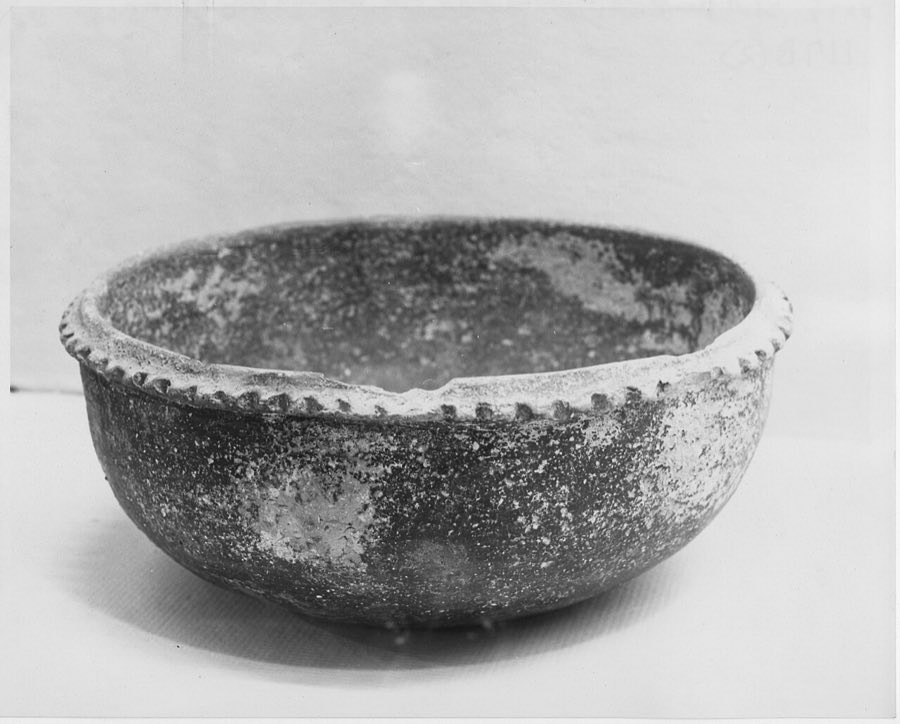

Material · ceramic
Shell-tempered earthenware
North America — Southeast, North America — Eastern Woodlands
Shell-tempered earthenware is pottery made with crushed mussel shell in the clay, the diagnostic ware of the Mississippian and Fort Ancient cultures of the Southeast and Midwest from about 900 to 1,700 CE. Shell allowed thinner walls and larger vessels. Mississippi Plain and Bell Plain are the principal types.
| Kind | ceramic |
|---|---|
| Regions | North America — Southeast, North America — Eastern Woodlands |
Sources
Mussel shell from the rivers of the Mississippi drainage was burnt and crushed; clays were local. The temper was crushed fine enough to pass through the potter's fingers without lumps.
Identification
The paste shows white platy shell fragments or, where the shell has leached, flat voids; surfaces are plain, burnished, slipped or painted. Vessels are globular jars with handles, bowls, bottles and effigies. Grog, grit and sand tempers mark other traditions.
Substitutes and fakes
Modern potters in the Southeast and Mexico produce shell-tempered reproductions; fakes lack soot, wear and leaching. Reconstruction from mixed sherds is common.
Cite this article
Stratum Strata. "Shell-tempered earthenware" (Material). Stratum Strata pack 2026.09, as of 2026-09-21. https://stratum.black/strata/materials/shell-tempered-earthenware. Accessed 2026-09-21.
@misc{stratum-shell-tempered-earthenware,
  title        = {Shell-tempered earthenware},
  author       = {{Stratum Strata}},
  howpublished = {\url{https://stratum.black/strata/materials/shell-tempered-earthenware}},
  year         = {2026},
  note         = {Material article, Stratum Strata pack 2026.09, as of 2026-09-21; sources: stratum, commons. Accessed 2026-09-21.}
}
Citations carry the pack version and the article's as-of date so they resolve to the same text later. The facts themselves belong to the sources listed below; cite those for the science.