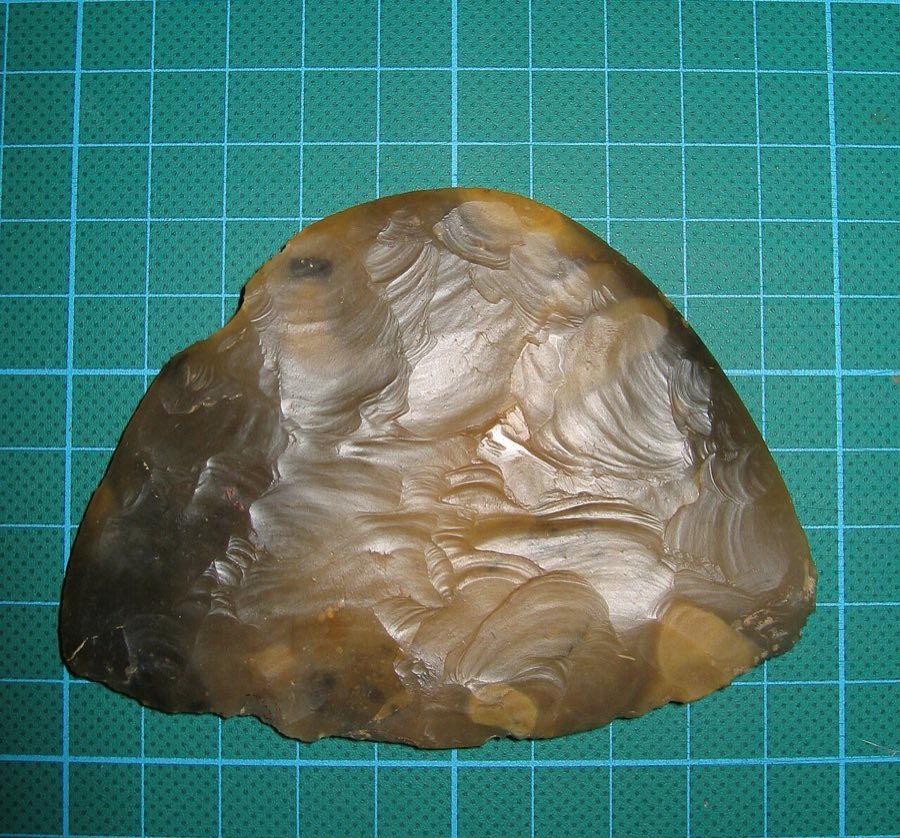

Discoidal · Mississippian
Discoidal
900–1600 CE, Mississippian, Cahokia, Fort Ancient
The discoidal or chunkey stone is the polished stone disc rolled in the Mississippian chunkey game across the Southeast and Midwest, about 900 to 1,600 CE, and into the Historic period. Highly polished examples in quartzite and granite with concave faces are the classic form. Cahokia examples are especially fine.
| Object | Discoidal |
|---|---|
| Dates | 900–1600 CE |
| Period | Mississippian |
| Cultures | Mississippian, Cahokia, Fort Ancient |
| Regions | North America — Eastern Woodlands, North America — Southeast |
Diagnostic traits
Highly polished stone disc with concave faces and rounded rim used in the chunkey game; also called chunkey stone.
Identification
Discoidals have concave or flat faces, a rounded rim and a high polish, and are distinguished from game stones and hammerstones by symmetry and finish; Jersey Bluff and Cahokia types have deeply cupped faces, while Salt River types are biconcave with a hole. Diameter is 5 to 15 cm. Materials are quartzite, granite and sandstone.
Reproductions and fakes
Discoidals are faked on lathes and grinders from cobbles; genuine pieces show pecking under the polish and wear on the rim. Modern examples are too perfectly circular.
Elsewhere
- Wikidata: Q111337177
Cite this article
Stratum Strata. "Discoidal" (Artifact type). Stratum Strata pack 2026.09, as of 2026-09-21. https://stratum.black/strata/types/discoidal. Accessed 2026-09-21.
@misc{stratum-discoidal,
  title        = {Discoidal},
  author       = {{Stratum Strata}},
  howpublished = {\url{https://stratum.black/strata/types/discoidal}},
  year         = {2026},
  note         = {Artifact type article, Stratum Strata pack 2026.09, as of 2026-09-21; sources: stratum, wikidata, commons. Accessed 2026-09-21.}
}
Citations carry the pack version and the article's as-of date so they resolve to the same text later. The facts themselves belong to the sources listed below; cite those for the science.