
Formation · Cretaceous
Pierre Shale
Late Cretaceous unit, South Dakota · Wyoming · Colorado · Montana
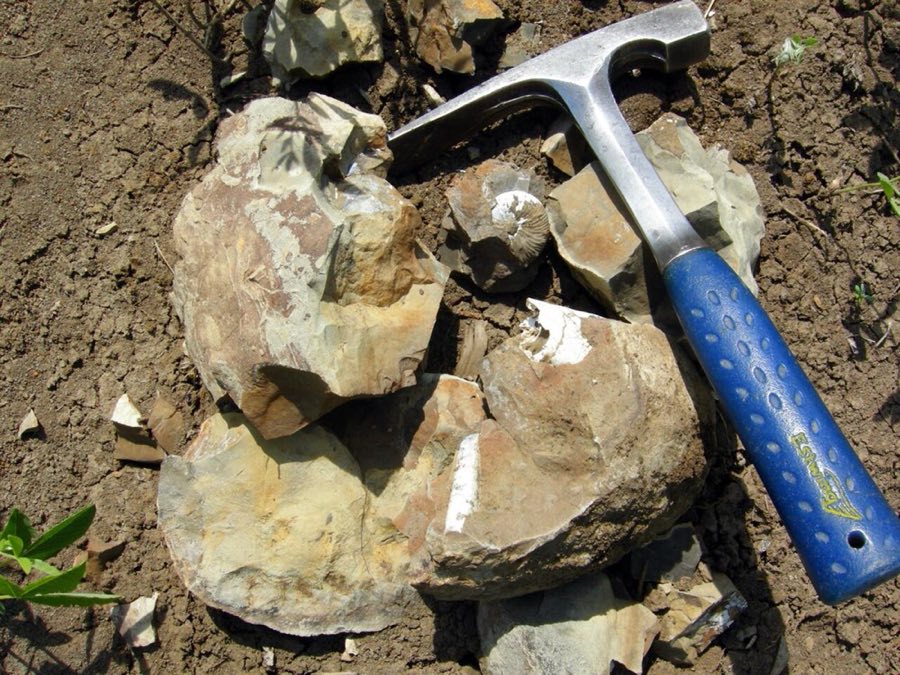
The Pierre Shale is the Campanian–Maastrichtian marine shale of the Great Plains and the best source of North American ammonites: iridescent Placenticeras, Baculites segments, scaphites and Sphenodiscus, plus mosasaur and plesiosaur bone. Concretions are split and prepared; a good Placenticeras with intact shell shows the red-green nacre that Alberta's Bearpaw Formation markets as ammolite. Ask whether the shell is original or if suture-exposed steinkerns have been polished, and whether the piece has been assembled from several concretion fragments.
| Country | United States |
|---|---|
| Region | South Dakota, Wyoming, Colorado, Montana, Nebraska, Kansas |
| Age | Campanian, Late Cretaceous |
| Age range | ~81–70 Ma |
| Macrostrat rank | Fm· Macrostrat |
| Macrostrat age | 84.1–71.2 Ma· Macrostrat |
| Lithology | shale, ash, clay· Macrostrat |
| Environment | offshore, coastal indet.· Macrostrat |
| Macrostrat columns | 8 column(s) sampled from 8 unit(s)· Macrostrat |
| Group (Macrostrat) | Montana· Macrostrat |
| PBDB collections | 412 collections, 1845 occurrences· Paleobiology Database |
Collecting and legality
Ammonite concretions come from private ranches along the Cheyenne and Belle Fourche rivers in South Dakota and from the Wyoming Pierre; federal parcels allow only casual invertebrate collecting for personal use with no sale. Some Canadian Bearpaw ammolite is a different, regulated product.
Lithology and setting
Dark marine shale with septarian and fossiliferous limestone concretions, deposited in the Western Interior Seaway over several million years.
Commonly recorded taxa (PBDB)
Genera most often recorded from this unit in the Paleobiology Database (first 200 occurrences): Inoceramus (28), Baculites (24), Hoploscaphites (19), Nuculana (10), Bryozoa (8), Discoscaphites (6), Dosiniopsis (6), Euspira (6), Protocardia (5), Tenuipteria (5), Cucullaea (4), Diploconcha (4), Nucula (4), Oxytoma (Hypoxytoma) (4), Anisomyon (3).
Source: Paleobiology Database
Elsewhere
- Macrostrat: 1571
- macrostratConcept: 9624
- PBDB: strata:Pierre
- Wikidata: Q7192447
- Macrostrat stratigraphic name
- PBDB occurrences for this unit
- Wikipedia: Pierre Shale
- Mindat: Pierre Shale
Cite this article
Stratum Study. "Pierre Shale" (Formation). Stratum Study pack 2026.09, as of 2026-09-19. https://stratum.black/study/formations/pierre-shale. Accessed 2026-09-20.
@misc{stratum-pierre-shale,
  title        = {Pierre Shale},
  author       = {{Stratum Study}},
  howpublished = {\url{https://stratum.black/study/formations/pierre-shale}},
  year         = {2026},
  note         = {Formation article, Stratum Study pack 2026.09, as of 2026-09-19; sources: stratum, macrostrat, pbdb, wikidata, commons. Accessed 2026-09-20.}
}
Citations carry the pack version and the article's as-of date so they resolve to the same text later. The facts themselves belong to the sources listed below; cite those for the science.