
Culture · Late Prehistoric
Ancestral Puebloan
500–1300 CE, North America — Southwest
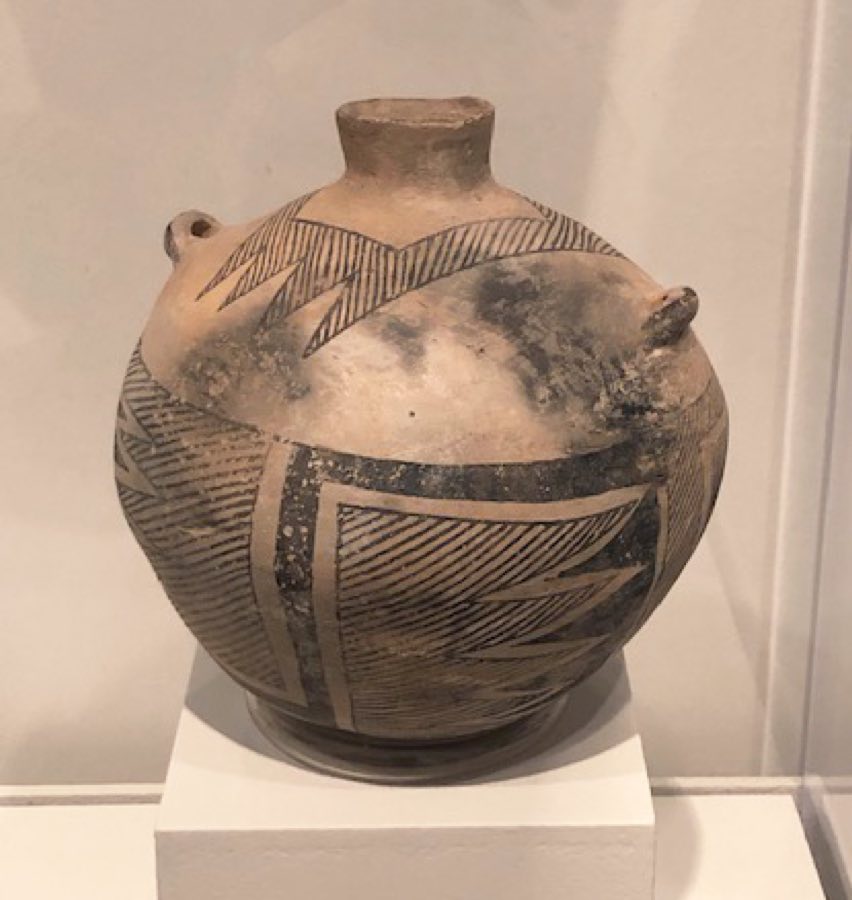
Ancestral Puebloan refers to the farming peoples of the Four Corners and Colorado Plateau from roughly 500 CE (and earlier as Basketmaker) to the great migrations around 1,300 CE; their descendants are the modern Pueblo nations. They built pit houses, then multi-storey masonry pueblos and cliff dwellings at Chaco, Mesa Verde and Kayenta. Collectors hold black-on-white and corrugated pottery, small arrowpoints, turquoise and shell beads and pendants, manos and axes, with textiles and sandals appearing from dry caves.
| Dates | 500–1300 CE |
|---|---|
| Period | Late Prehistoric |
| Region | North America — Southwest |
| Areas | Four Corners, Colorado Plateau, Rio Grande |
| Typical objects | Bowl, Jar, Projectile point, Bead, Pendant |
| Typical materials | Chert, Obsidian, Turquoise, Marine shell |
Identification
Black-on-white pottery with mineral or carbon paint on white slip and grey corrugated cooking jars are the hallmarks; regional styles such as Mesa Verde, Chaco, Tusayan and Kayenta differ in paint and design. Points are small: Rose Springs corner-notched, Desert side-notched and Cottonwood triangles. Turquoise mosaic, jet, shell bracelets and full-grooved and notched axes complete the picture.
Legality
In the United States, prehistoric artifacts may be collected and sold only when they come from private land with the landowner's permission; removal from federal, tribal or most state land is prohibited under ARPA and state statutes. Funerary objects, human remains and sacred items are covered by NAGPRA and are not legitimately traded, and Canadian provinces treat archaeological finds as Crown or provincial property. Most of the Four Corners is federal, tribal or state land, ARPA prosecutions have been frequent, and the Pueblo nations regard burial pottery and ceremonial objects as culturally affiliated under NAGPRA.
Reproductions and fakes
Anasazi pottery has been faked since the early twentieth century and modern reproductions from New Mexico and Mexico are abundant, often sold as 'reproduction' and later passed as ancient. Signs include uniform white slip without crazing, painted designs that ignore ancient layout rules, no interior use wear and a smell of fresh clay. Genuine vessels almost always show fire clouds, spalling and mineral deposits.
Elsewhere
- Wikidata: Q478805
- Wikipedia: Ancestral Puebloans
Cite this article
Stratum Study. "Ancestral Puebloan" (Culture). Stratum Study pack 2026.09, as of 2026-09-21. https://stratum.black/study/cultures/ancestral-puebloan. Accessed 2026-09-21.
@misc{stratum-ancestral-puebloan,
  title        = {Ancestral Puebloan},
  author       = {{Stratum Study}},
  howpublished = {\url{https://stratum.black/study/cultures/ancestral-puebloan}},
  year         = {2026},
  note         = {Culture article, Stratum Study pack 2026.09, as of 2026-09-21; sources: stratum, wikidata, commons. Accessed 2026-09-21.}
}
Citations carry the pack version and the article's as-of date so they resolve to the same text later. The facts themselves belong to the sources listed below; cite those for the science.