
Material · lithic
Turquoise
North America — Southwest, Mesoamerica
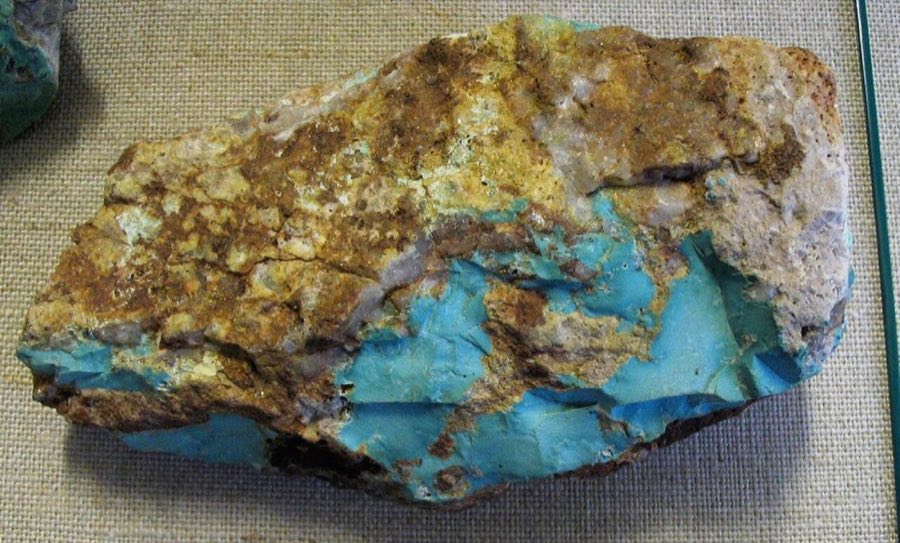
Turquoise is the blue-green copper phosphate mined in the American Southwest and northern Mexico from the Ancestral Puebloan and Hohokam periods onward and traded into Mesoamerica for Aztec and Mixtec mosaics. Chaco Canyon held tens of thousands of pieces. Beads, pendants and mosaic tesserae are the ancient forms.
| Kind | lithic |
|---|---|
| Regions | North America — Southwest, Mesoamerica |
Sources
Ancient mines include Cerrillos in New Mexico, Kingman and Morenci in Arizona, the Mojave sources of California and Nevada and Zacatecas in Mexico; Old World turquoise came from Sinai and Nishapur in Iran. Isotope studies now trace Chaco and Aztec turquoise to specific Southwestern mines.
Identification
Turquoise is opaque sky blue to green, waxy, soft and often veined with brown or black matrix; ancient pieces are often greener from ageing and are drilled with tapered holes. Stabilised and dyed modern turquoise and howlite imitations are common.
Substitutes and fakes
Modern turquoise beads and mosaics are sold as ancient, and genuine ancient tesserae are re-set into new mosaics. Look for rotary drill holes, stabilisation resin and uniform colour.
Elsewhere
- Wikidata: Q165254
- Wikipedia: turquoise
Cite this article
Stratum Study. "Turquoise" (Material). Stratum Study pack 2026.09, as of 2026-09-21. https://stratum.black/study/materials/turquoise. Accessed 2026-09-21.
@misc{stratum-turquoise,
  title        = {Turquoise},
  author       = {{Stratum Study}},
  howpublished = {\url{https://stratum.black/study/materials/turquoise}},
  year         = {2026},
  note         = {Material article, Stratum Study pack 2026.09, as of 2026-09-21; sources: stratum, wikidata, commons. Accessed 2026-09-21.}
}
Citations carry the pack version and the article's as-of date so they resolve to the same text later. The facts themselves belong to the sources listed below; cite those for the science.