
Material · lithic
Knife River flint
North America — Great Plains
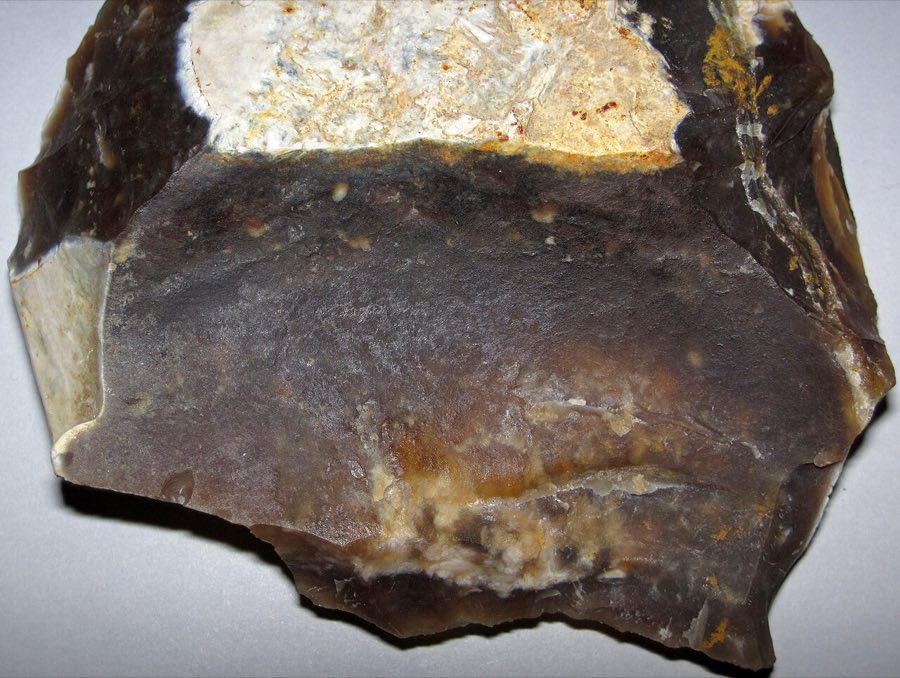
Knife River flint is the dark brown, translucent silicified lignite from western North Dakota that was quarried from Paleoindian times and traded across the Plains and into the Hopewell world. It is the premier material of Northern Plains prehistory. Cody, Pelican Lake and Besant points in it are especially collected.
| Kind | lithic |
|---|---|
| Regions | North America — Great Plains |
Sources
The primary quarries lie in Dunn and Mercer counties, North Dakota, near the Knife River, where thousands of quarry pits are preserved; cobbles also occur in glacial and river gravels across the Dakotas and into Manitoba and Saskatchewan. It formed as silicified peat in Paleocene sediments.
Identification
The stone is coffee to root-beer brown, translucent at the edges, with a glassy lustre and occasional plant fossils; weathered surfaces develop a light tan or whitish patina. It is easily confused with brown chalcedonies from Montana and Texas. Freshly broken surfaces are uniformly dark.
Substitutes and fakes
Modern knappers use Knife River flint widely, and the glassy fresh surface of a new point contrasts with the patinated rind of an old one. Smoke-blackening is sometimes applied to imitate hearth exposure.
Cite this article
Stratum Strata. "Knife River flint" (Material). Stratum Strata pack 2026.09, as of 2026-09-21. https://stratum.black/strata/materials/knife-river-flint. Accessed 2026-09-21.
@misc{stratum-knife-river-flint,
  title        = {Knife River flint},
  author       = {{Stratum Strata}},
  howpublished = {\url{https://stratum.black/strata/materials/knife-river-flint}},
  year         = {2026},
  note         = {Material article, Stratum Strata pack 2026.09, as of 2026-09-21; sources: stratum, commons. Accessed 2026-09-21.}
}
Citations carry the pack version and the article's as-of date so they resolve to the same text later. The facts themselves belong to the sources listed below; cite those for the science.