
Culture · Paleoindian
Clovis
11050–10800 BCE, North America — Great Plains
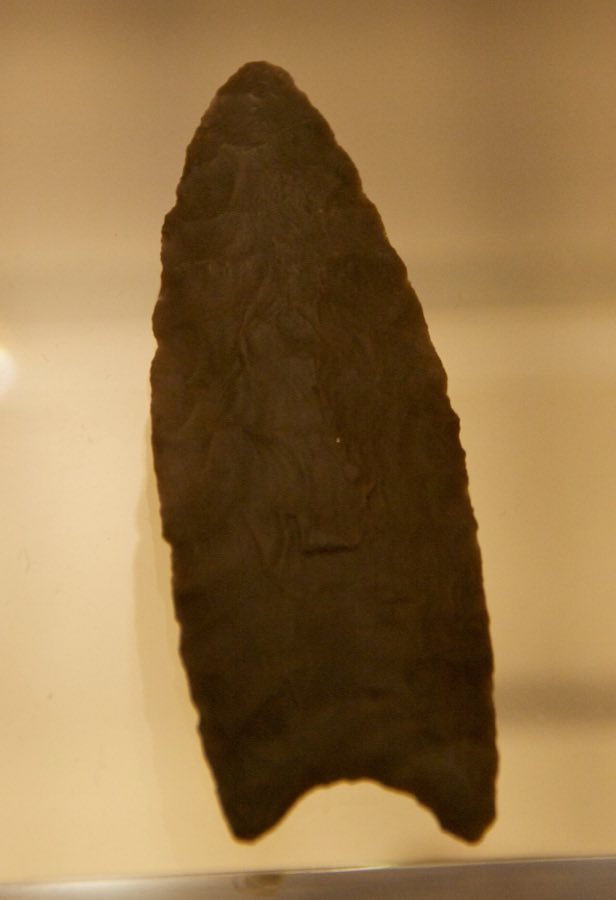
Clovis is the earliest widely recognised Paleoindian tradition in North America, dated to a few centuries around 11,000 BCE and spread from Canada to northern Mexico. It is known almost entirely from stone tools, mammoth and bison kill sites and a handful of caches of oversized bifaces and blades. Collectors hold fluted points, large blades, end scrapers and occasional cache bifaces, and a documented Clovis point is one of the most sought-after single objects in American prehistoric collecting.
| Dates | 11050–10800 BCE |
|---|---|
| Period | Paleoindian |
| Region | North America — Great Plains |
| Areas | Continental United States, Southern Canada, Northern Mexico |
| Typical objects | Projectile point, Blade, Scraper, Biface |
| Typical materials | Chert, Obsidian, Alibates agatized dolomite, Knife River flint |
Identification
The diagnostic object is the fluted lanceolate point with a concave base, short flutes on one or both faces and heavily ground lower edges. Clovis toolkits also include prismatic blades struck from prepared cores, end scrapers with graver spurs and large ovate bifaces, often in high-grade materials carried far from their source. Look for overshot flaking scars that run across the full width of a biface, a strong Clovis signature.
Legality
In the United States, prehistoric artifacts may be collected and sold only when they come from private land with the landowner's permission; removal from federal, tribal or most state land is prohibited under ARPA and state statutes. Funerary objects, human remains and sacred items are covered by NAGPRA and are not legitimately traded, and Canadian provinces treat archaeological finds as Crown or provincial property. Clovis material additionally attracts scrutiny because several famous finds came from federal land or well-known excavated sites.
Reproductions and fakes
Clovis points are among the most faked objects in the hobby: modern knappers produce convincing flutes on old-looking chert, then age the surface with acids, tumbling, burial or heat. Warning signs are flutes struck after the edges were finished, fresh-looking flake scars under magnification, uniform patina in the flutes and on the faces, and a lack of basal grinding. Any Clovis point without a find history should be treated as modern until proven otherwise.
Elsewhere
- Wikidata: Q3485378
- Wikipedia: Clovis culture
Cite this article
Stratum Strata. "Clovis" (Culture). Stratum Strata pack 2026.09, as of 2026-09-21. https://stratum.black/strata/cultures/clovis. Accessed 2026-09-21.
@misc{stratum-clovis,
  title        = {Clovis},
  author       = {{Stratum Strata}},
  howpublished = {\url{https://stratum.black/strata/cultures/clovis}},
  year         = {2026},
  note         = {Culture article, Stratum Strata pack 2026.09, as of 2026-09-21; sources: stratum, wikidata, commons. Accessed 2026-09-21.}
}
Citations carry the pack version and the article's as-of date so they resolve to the same text later. The facts themselves belong to the sources listed below; cite those for the science.