
Culture · Late Prehistoric
Plains Village
900–1750 CE, North America — Great Plains
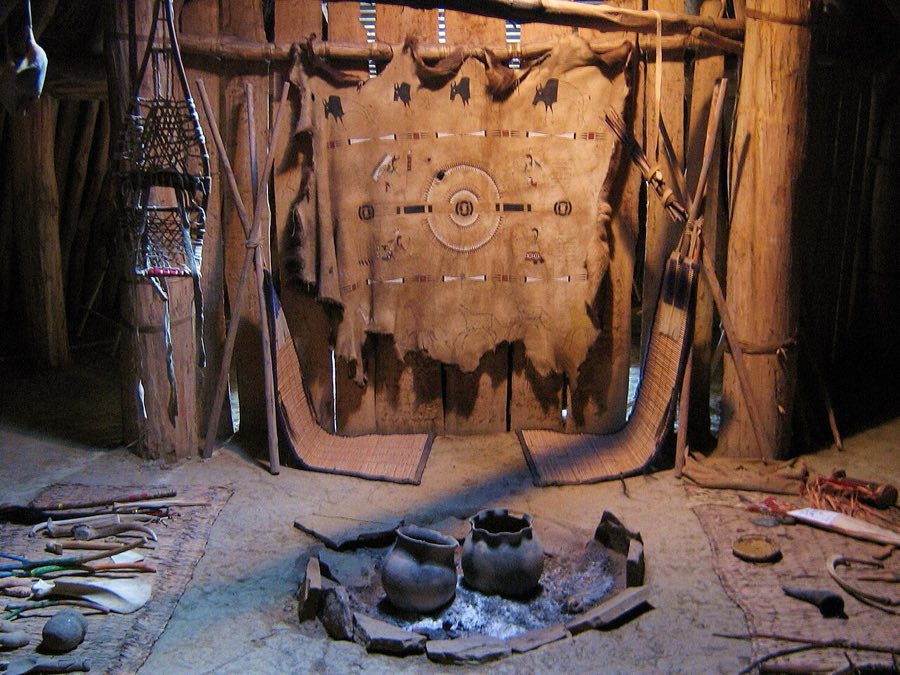
Plains Village describes the semi-sedentary farming villages of the Missouri River and Central and Southern Plains from about 900 to 1,750 CE, ancestral to the Mandan, Hidatsa, Arikara, Pawnee, Wichita and others. People lived in earth lodges, grew maize and hunted bison seasonally. Collectors hold small triangular and side-notched arrowpoints, end scrapers, bison scapula hoes, grit-tempered pottery and, from late sites, glass beads and metal trade goods.
| Dates | 900–1750 CE |
|---|---|
| Period | Late Prehistoric |
| Region | North America — Great Plains |
| Areas | Missouri River, Central Plains, Southern Plains |
| Typical objects | Projectile point, Jar, Scraper, Celt |
| Typical materials | Knife River flint, Alibates agatized dolomite, Grog-tempered earthenware, Bone and antler |
Identification
Plains Village assemblages combine small Fresno and Plains side-notched arrowpoints, snub-nosed end scrapers, grooved mauls, bone hoes made from bison shoulder blades and cord-roughened or simple-stamped grit-tempered jars with thickened rims. Knife River flint and Alibates are the main stone. Village sites are marked by depressions, cache pits and fortification ditches.
Legality
In the United States, prehistoric artifacts may be collected and sold only when they come from private land with the landowner's permission; removal from federal, tribal or most state land is prohibited under ARPA and state statutes. Funerary objects, human remains and sacred items are covered by NAGPRA and are not legitimately traded, and Canadian provinces treat archaeological finds as Crown or provincial property. Many village sites on the Missouri lie on Corps of Engineers or reservation land and their cemeteries are protected under NAGPRA; Nebraska and the Dakotas have strong burial laws.
Reproductions and fakes
Plains Village material is low-value and rarely faked, though bison-scapula hoes are sometimes freshly made from butchered bone. Arrowpoints in Knife River flint are reproduced by hobbyist knappers.
Elsewhere
- Wikidata: Q60761528
- Wikipedia: Plains Village period
Cite this article
Stratum Strata. "Plains Village" (Culture). Stratum Strata pack 2026.09, as of 2026-09-21. https://stratum.black/strata/cultures/plains-village. Accessed 2026-09-21.
@misc{stratum-plains-village,
  title        = {Plains Village},
  author       = {{Stratum Strata}},
  howpublished = {\url{https://stratum.black/strata/cultures/plains-village}},
  year         = {2026},
  note         = {Culture article, Stratum Strata pack 2026.09, as of 2026-09-21; sources: stratum, wikidata, commons. Accessed 2026-09-21.}
}
Citations carry the pack version and the article's as-of date so they resolve to the same text later. The facts themselves belong to the sources listed below; cite those for the science.