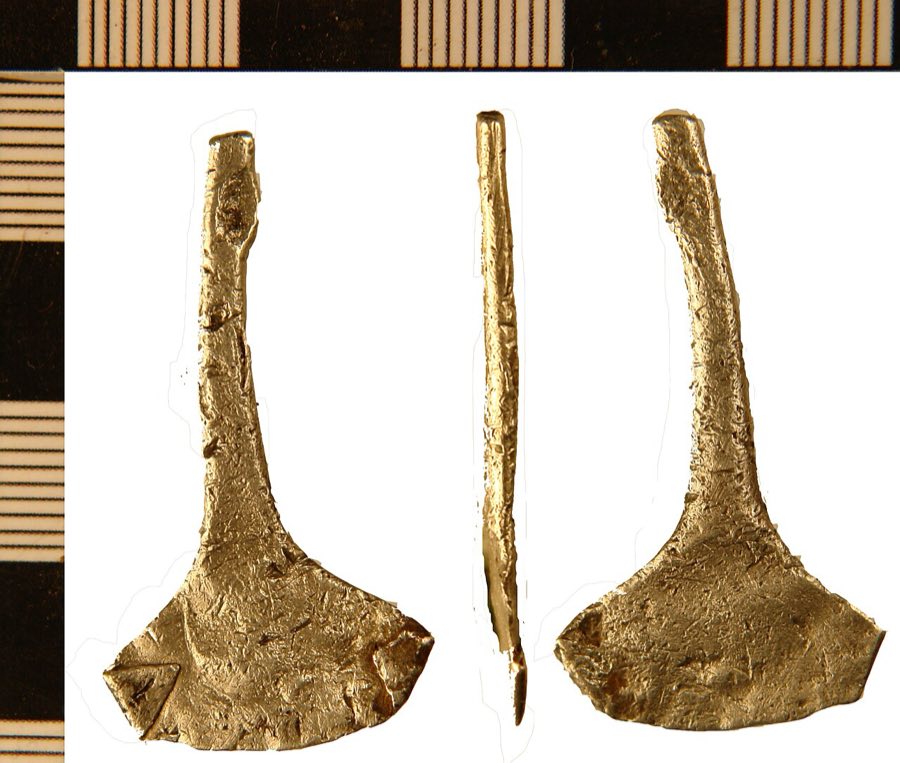

Pendant · Early Medieval
Thor's hammer pendant
850–1100 CE, Viking
Thor's hammer pendants were worn across Scandinavia, the Danelaw and the Rus lands in the ninth to eleventh centuries, at the time Christianity was spreading and the cross pendant was its rival. Silver examples from hoards and graves are the finest, including the filigree hammers of Scania and Iceland; iron hammers on rings are a separate Swedish tradition. Numbers have risen with metal detecting in England and Denmark, and the type is now a firm favourite of dealers.
| Object | Pendant |
|---|---|
| Dates | 850–1100 CE |
| Period | Early Medieval |
| Cultures | Viking |
| Regions | Europe — Northern & British Isles, Europe — Western & Central |
Diagnostic traits
A small T-shaped pendant of silver, bronze, iron or amber, 15–50 mm long, with a short hammer head and a shaft ending in a suspension loop, sometimes with punched or filigree ornament.
Identification
The hammer has a squared head and a shaft ending in a loop; an axe-shaped pendant, a Rus fashion, has an asymmetrical blade. A cross pendant of the same date is easy to distinguish, but some hammers were deliberately ambiguous. Modern Norse revival jewellery copies the Skåne filigree hammer in exact detail.
Reproductions and fakes
This is the most reproduced Viking object: cast pewter and silver copies are sold at every re-enactment fair and are often aged and passed off as finds. Genuine silver has a dark tarnish in the recesses and wear on the loop; bronze shows an uneven green patina; an artificially blackened surface that rubs off is a bad sign.
Cite this article
Stratum Study. "Thor's hammer pendant" (Artifact type). Stratum Study pack 2026.09, as of 2026-09-21. https://stratum.black/study/types/thor-s-hammer-pendant. Accessed 2026-09-21.
@misc{stratum-thor-s-hammer-pendant,
  title        = {Thor's hammer pendant},
  author       = {{Stratum Study}},
  howpublished = {\url{https://stratum.black/study/types/thor-s-hammer-pendant}},
  year         = {2026},
  note         = {Artifact type article, Stratum Study pack 2026.09, as of 2026-09-21; sources: stratum, commons. Accessed 2026-09-21.}
}
Citations carry the pack version and the article's as-of date so they resolve to the same text later. The facts themselves belong to the sources listed below; cite those for the science.