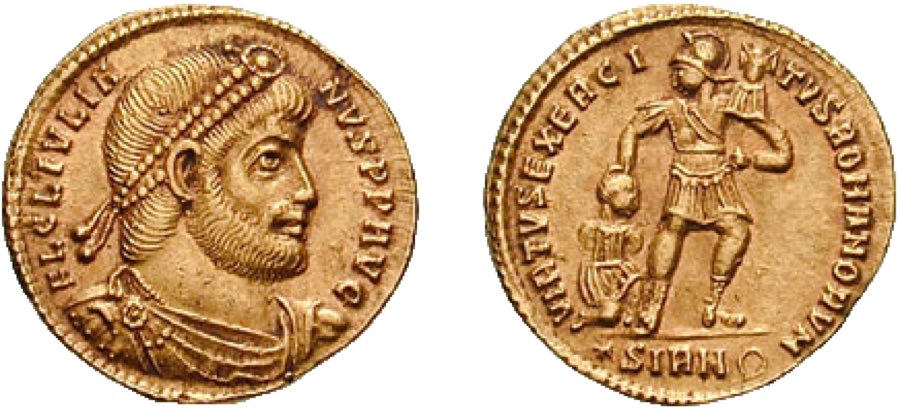

Coin · Late Antique
Solidus
309–1092 CE, Roman, Byzantine
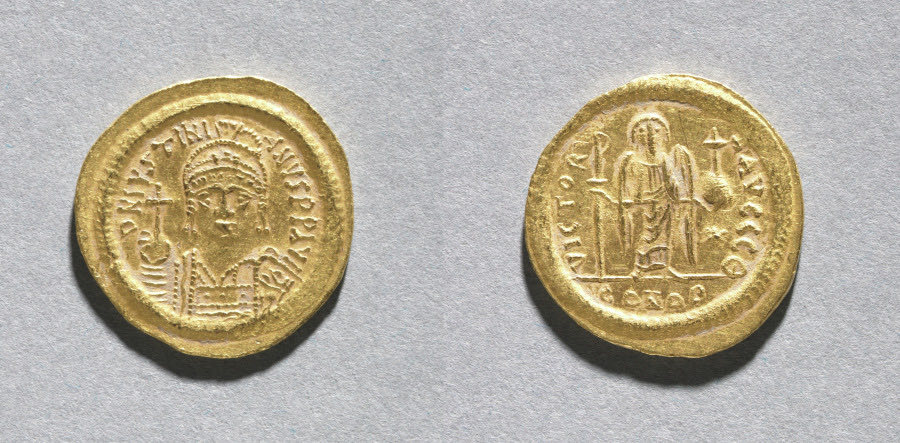
Constantine I introduced the solidus in 309 CE and it held its weight and purity for seven centuries, becoming the standard gold coin of the Mediterranean and the model for the Byzantine nomisma until Alexius I's reform in 1092. Late Roman issues show the emperor in profile with Victory or the seated Roma on the reverse; Byzantine issues from Justinian II onwards show Christ, the Virgin or the cross on steps. Solidi were struck at Constantinople, Thessalonica, Ravenna, Antioch and other mints, each with a mint mark and officina letter.
| Object | Coin |
|---|---|
| Dates | 309–1092 CE |
| Period | Late Antique |
| Cultures | Roman, Byzantine |
| Regions | Europe — Mediterranean, Near East & Mesopotamia |
Diagnostic traits
A thin, broad gold coin of about 4.4–4.5 g (1/72 of a Roman pound) with a frontal or profile imperial bust and, from the seventh century, Christian iconography on the reverse.
Identification
The solidus is thinner and broader than the Republican and early Imperial aureus and has CONOB or COMOB in the exergue on many issues. The semissis and tremissis are half and third pieces of the same design. Later cup-shaped histamena and the debased electrum coins after the 1040s are distinguishable by their concave flan and paler colour.
Reproductions and fakes
Gold-plated and gold-alloy casts with mushy lettering are common on online markets, and some genuine dies were used in antiquity for plated fourrées; check weight, specific gravity and the sharpness of the lettering. Genuine solidi often show light scratches and edge marks from circulation but never corrosion.
Photographs
Elsewhere
- Wikidata: Q231455
- Wikipedia: solidus
Cite this article
Stratum Study. "Solidus" (Artifact type). Stratum Study pack 2026.09, as of 2026-09-21. https://stratum.black/study/types/solidus. Accessed 2026-09-21.
@misc{stratum-solidus,
  title        = {Solidus},
  author       = {{Stratum Study}},
  howpublished = {\url{https://stratum.black/study/types/solidus}},
  year         = {2026},
  note         = {Artifact type article, Stratum Study pack 2026.09, as of 2026-09-21; sources: stratum, wikidata, commons, cleveland. Accessed 2026-09-21.}
}
Citations carry the pack version and the article's as-of date so they resolve to the same text later. The facts themselves belong to the sources listed below; cite those for the science.