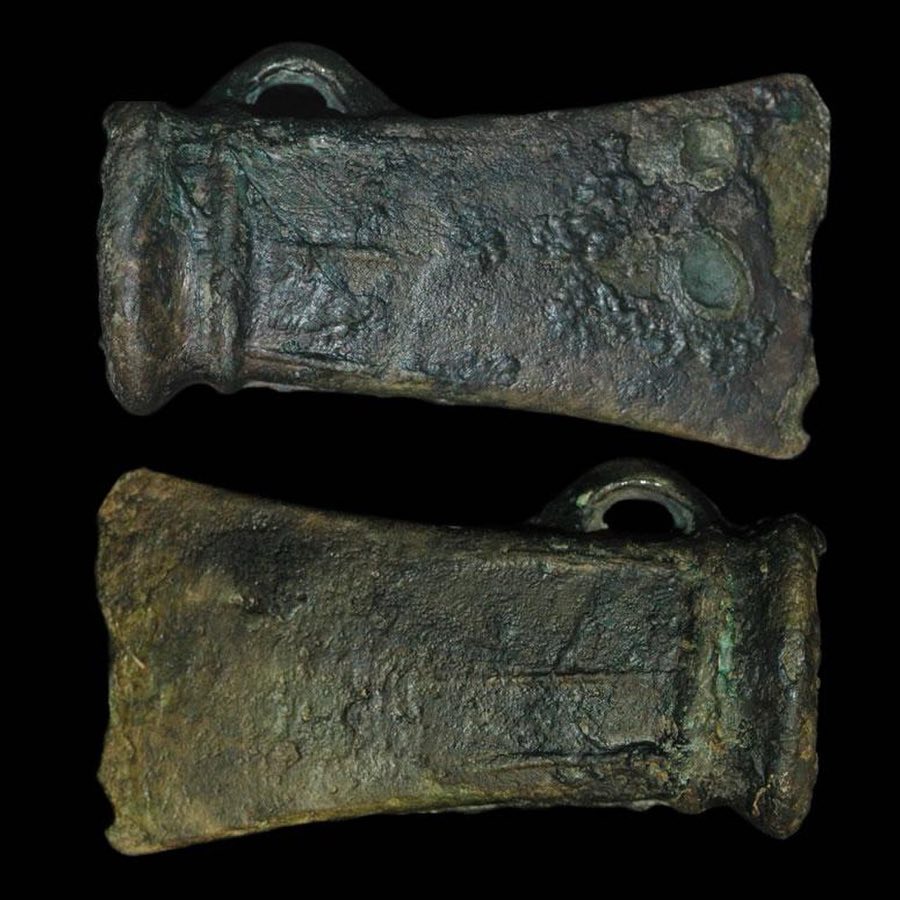

Axe head · Late Bronze Age
Socketed axe
1200–700 BCE, Urnfield
The socketed axe is the Late Bronze Age axe of Europe, about 1,200 to 700 BCE, hollow-cast with a socket for the haft and usually a side loop. It was produced in enormous numbers and is the commonest object in Late Bronze Age hoards. Regional types such as Ewart Park and Sompting are dated by form.
| Object | Axe head |
|---|---|
| Dates | 1200–700 BCE |
| Period | Late Bronze Age |
| Cultures | Urnfield |
| Regions | Europe — Western & Central, Europe — Northern & British Isles |
Diagnostic traits
Hollow-cast bronze axe with a rectangular or oval socket, a side loop and a slightly flared blade; regional variants by decoration and section.
Identification
Socketed axes are hollow with a rectangular or oval socket and a loop, unlike palstaves, which are solid with flanges. Decoration includes ribs, pellets and wing motifs. Socket mouth mouldings and body section define types.
Reproductions and fakes
Cast new from moulds taken off genuine axes; fakes lack the internal casting core marks and have a uniform patina. Genuine examples show wear inside the socket and a filed casting seam.
Elsewhere
- Wikidata: Q17629678
Cite this article
Stratum Study. "Socketed axe" (Artifact type). Stratum Study pack 2026.09, as of 2026-09-21. https://stratum.black/study/types/socketed-axe. Accessed 2026-09-21.
@misc{stratum-socketed-axe,
  title        = {Socketed axe},
  author       = {{Stratum Study}},
  howpublished = {\url{https://stratum.black/study/types/socketed-axe}},
  year         = {2026},
  note         = {Artifact type article, Stratum Study pack 2026.09, as of 2026-09-21; sources: stratum, wikidata, commons. Accessed 2026-09-21.}
}
Citations carry the pack version and the article's as-of date so they resolve to the same text later. The facts themselves belong to the sources listed below; cite those for the science.