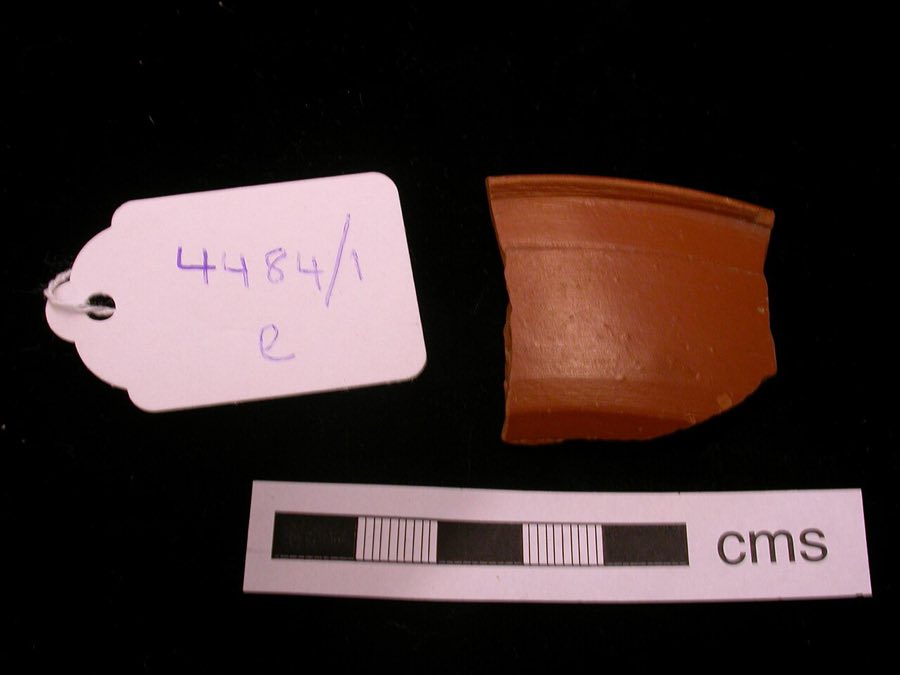

Bowl · Roman Empire
Samian ware bowl
30–250 CE, Roman
The samian ware bowl is the glossy red-slipped terra sigillata of Gaulish workshops at La Graufesenque, Lezoux and Rheinzabern, made from about 30 to 250 CE and traded across the western empire, especially Britain. Bowls were plain or mould-decorated, and potters' stamps and decorative schemes date them closely. It is the key dating tool of Roman Britain.
| Object | Bowl |
|---|---|
| Dates | 30–250 CE |
| Period | Roman Empire |
| Cultures | Roman |
| Regions | Europe — Western & Central, Europe — Northern & British Isles, Europe — Mediterranean |
Diagnostic traits
Glossy red-slipped Gaulish terra sigillata, plain or mould-decorated (Dragendorff 37 hemispherical bowls); potters' stamps on the base.
Identification
Samian has a fine red fabric and a lustrous, non-porous red slip, unlike coarse wares and unlike Arretine, which is earlier and Italian; Dragendorff 37 is a hemispherical decorated bowl, Drag. 18/31 a plain dish. Stamps on the base name the potter. Later African Red Slip is orange and matte.
Reproductions and fakes
Rarely faked but sherds are reassembled into 'complete' bowls with extensive fill; ultraviolet shows it. Modern reproductions for museums are marked.
Cite this article
Stratum Study. "Samian ware bowl" (Artifact type). Stratum Study pack 2026.09, as of 2026-09-21. https://stratum.black/study/types/samian-ware-bowl. Accessed 2026-09-21.
@misc{stratum-samian-ware-bowl,
  title        = {Samian ware bowl},
  author       = {{Stratum Study}},
  howpublished = {\url{https://stratum.black/study/types/samian-ware-bowl}},
  year         = {2026},
  note         = {Artifact type article, Stratum Study pack 2026.09, as of 2026-09-21; sources: stratum, commons. Accessed 2026-09-21.}
}
Citations carry the pack version and the article's as-of date so they resolve to the same text later. The facts themselves belong to the sources listed below; cite those for the science.