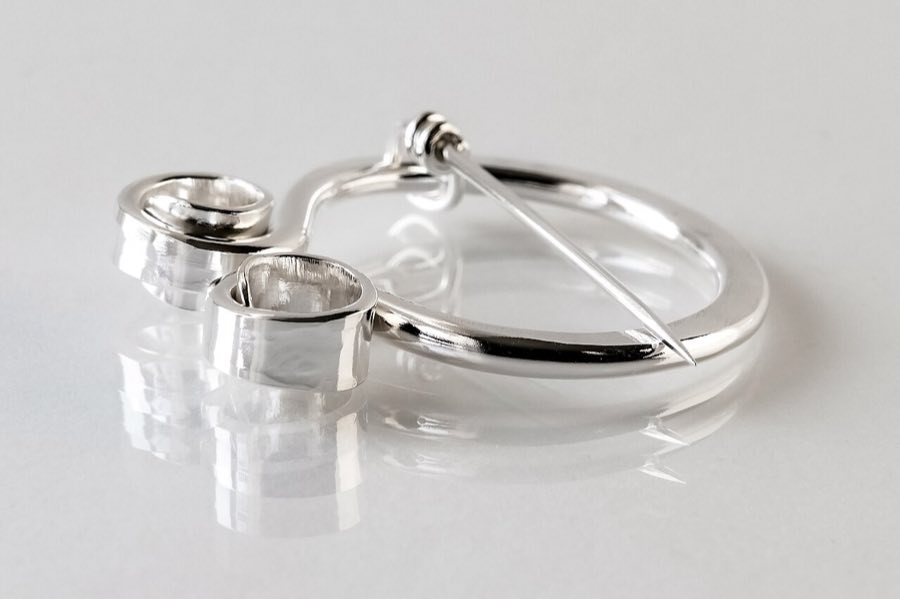

Brooch · Early Medieval
Penannular brooch
300–1000 CE, Viking
The penannular brooch is the open ring brooch with a free pin used from the Roman period through the Early Medieval British Isles and Scandinavia, about 300 to 1,000 CE, in forms from plain iron rings to the great silver-gilt Irish and Pictish brooches. Vikings adopted the type in Ireland and Scotland. It fastened cloaks at the shoulder.
| Object | Brooch |
|---|---|
| Dates | 300–1000 CE |
| Period | Early Medieval |
| Cultures | Viking |
| Regions | Europe — Northern & British Isles |
Diagnostic traits
Open ring with expanded or zoomorphic terminals and a free-moving pin; Irish and Scottish examples are richly decorated.
Identification
The open ring with expanded or zoomorphic terminals and a pin longer than the ring's diameter distinguish it from annular and disc brooches; Fowler types by terminal form date the sequence. Irish pseudo-penannular brooches have a closed ring. Viking examples are thistle or ball-headed.
Reproductions and fakes
Reproduced in silver and bronze for jewellery and reenactment; genuine pieces show wear where the pin swivels and a patina consistent with burial. Grand examples offered privately are suspect.
Elsewhere
- Wikidata: Q119241285
Cite this article
Stratum Study. "Penannular brooch" (Artifact type). Stratum Study pack 2026.09, as of 2026-09-21. https://stratum.black/study/types/penannular-brooch. Accessed 2026-09-21.
@misc{stratum-penannular-brooch,
  title        = {Penannular brooch},
  author       = {{Stratum Study}},
  howpublished = {\url{https://stratum.black/study/types/penannular-brooch}},
  year         = {2026},
  note         = {Artifact type article, Stratum Study pack 2026.09, as of 2026-09-21; sources: stratum, wikidata, commons. Accessed 2026-09-21.}
}
Citations carry the pack version and the article's as-of date so they resolve to the same text later. The facts themselves belong to the sources listed below; cite those for the science.