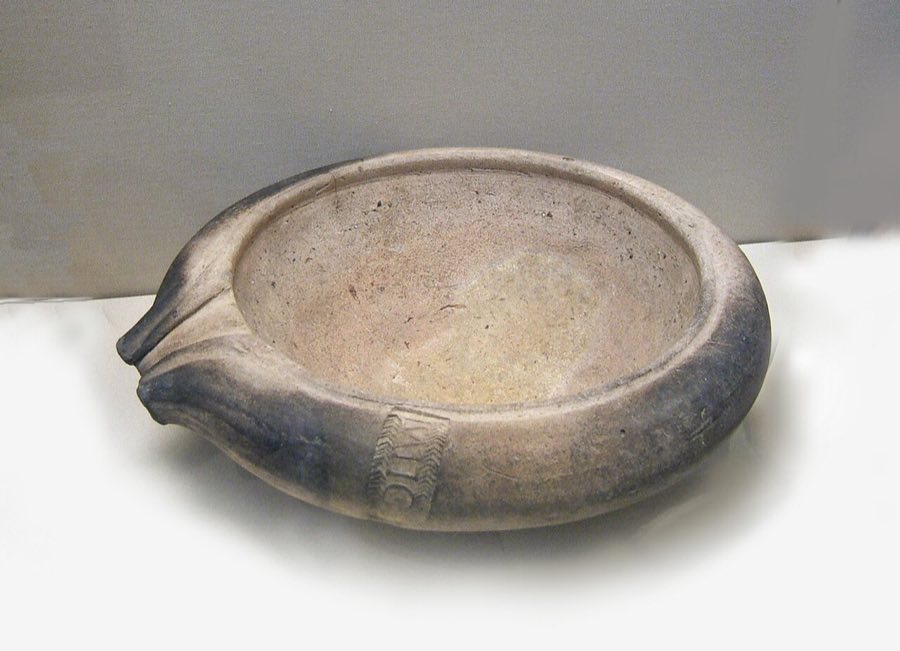

Bowl · Roman Empire
Mortarium
50 BCE–400 CE, Roman
Mortaria are the Roman kitchen's grinding bowl, made in Italy and Gaul and, from the late first century, in British potteries at Verulamium, Brockley Hill, Mancetter-Hartshill and Oxford. Many are stamped with the potter's name on the rim, which allows close dating, and rim profiles evolve from bead-and-flange to tall hammer-head forms in the third century. Complete examples are scarce; rim sherds with stamps are a recognised study field.
| Object | Bowl |
|---|---|
| Dates | 50 BCE–400 CE |
| Period | Roman Empire |
| Cultures | Roman |
| Regions | Europe — Western & Central, Europe — Northern & British Isles, Europe — Mediterranean |
Diagnostic traits
A heavy wheel-thrown pottery bowl with a hooked or flanged rim, a pouring spout and a coarse grit of quartz or crushed pottery embedded in the interior surface for grinding.
Identification
The gritted interior is unmistakable and separates a mortarium from any other flanged bowl; a Samian ware form 45 mortarium has the same grit but a fine red slip and a lion-head spout. Post-Roman and medieval bowls with internal grit do not exist in Britain, so a gritted sherd is Roman by default.
Reproductions and fakes
Not worth faking; the risk is misdescription of unstamped sherds as being from a named pottery. Genuine sherds show worn grit at the base of the bowl from use.
Elsewhere
- Wikidata: Q1948673
- Wikipedia: mortarium
Cite this article
Stratum Study. "Mortarium" (Artifact type). Stratum Study pack 2026.09, as of 2026-09-21. https://stratum.black/study/types/mortarium. Accessed 2026-09-21.
@misc{stratum-mortarium,
  title        = {Mortarium},
  author       = {{Stratum Study}},
  howpublished = {\url{https://stratum.black/study/types/mortarium}},
  year         = {2026},
  note         = {Artifact type article, Stratum Study pack 2026.09, as of 2026-09-21; sources: stratum, wikidata, commons. Accessed 2026-09-21.}
}
Citations carry the pack version and the article's as-of date so they resolve to the same text later. The facts themselves belong to the sources listed below; cite those for the science.