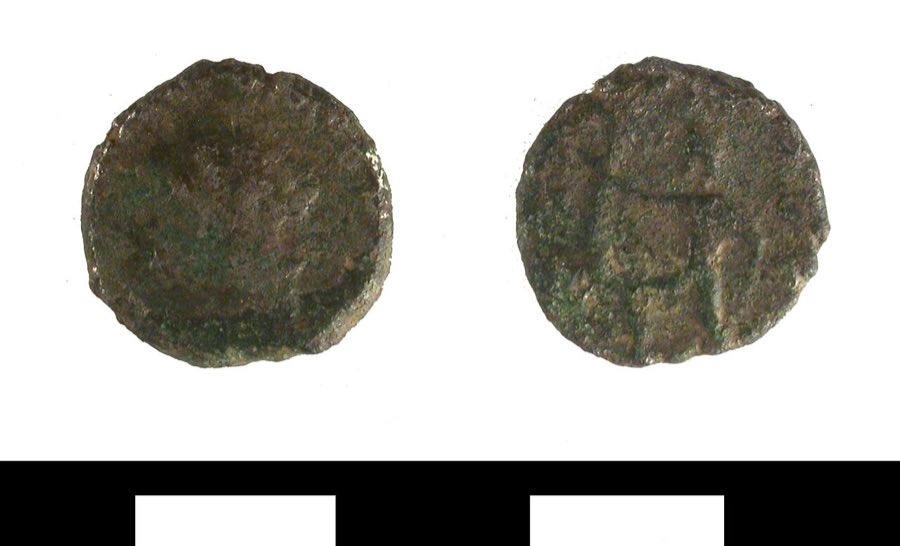

Coin · Roman Empire
Antoninianus
215–295 CE, Roman
Introduced by Caracalla in 215 CE as a double denarius, the antoninianus became the workhorse coin of the third-century crisis, with vast issues by Gallienus, Claudius II, Postumus, Victorinus and Tetricus of the Gallic Empire. By the 270s it was a copper coin of under 3 g with a thin silver surface, and huge hoards make it the cheapest Roman coin available. Aurelian's reform in 274 restored a slightly better coin with the XXI mark; Diocletian's reform of the 290s ended the series.
| Object | Coin |
|---|---|
| Dates | 215–295 CE |
| Period | Roman Empire |
| Cultures | Roman |
| Regions | Europe — Mediterranean, Europe — Western & Central, Europe — Northern & British Isles |
Diagnostic traits
A Roman coin showing the emperor with a radiate crown (or an empress on a crescent) on the obverse, initially silver of about 5 g and degrading to a small bronze with a silver wash.
Identification
The radiate crown on a male portrait is the diagnostic; a denarius of the same period has a laureate head and is smaller and rarer. Barbarous radiates are crude local copies from Britain and Gaul with blundered legends and tiny flans, and are a distinct collecting field. The later nummus and follis have laureate heads and mint marks in the exergue.
Reproductions and fakes
Genuine antoniniani are so cheap that forgery is rare, but cast copies of scarce emperors (Pacatian, Domitian II) exist; look for casting bubbles and a soft edge. Excavated pieces often carry a green or black patina with traces of silvering in the recesses.
Elsewhere
- Wikidata: Q599170
- Wikipedia: antoninianus
Cite this article
Stratum Study. "Antoninianus" (Artifact type). Stratum Study pack 2026.09, as of 2026-09-21. https://stratum.black/study/types/antoninianus. Accessed 2026-09-21.
@misc{stratum-antoninianus,
  title        = {Antoninianus},
  author       = {{Stratum Study}},
  howpublished = {\url{https://stratum.black/study/types/antoninianus}},
  year         = {2026},
  note         = {Artifact type article, Stratum Study pack 2026.09, as of 2026-09-21; sources: stratum, wikidata, commons. Accessed 2026-09-21.}
}
Citations carry the pack version and the article's as-of date so they resolve to the same text later. The facts themselves belong to the sources listed below; cite those for the science.