
Coin · Achaemenid
Achaemenid siglos
520–330 BCE, Achaemenid
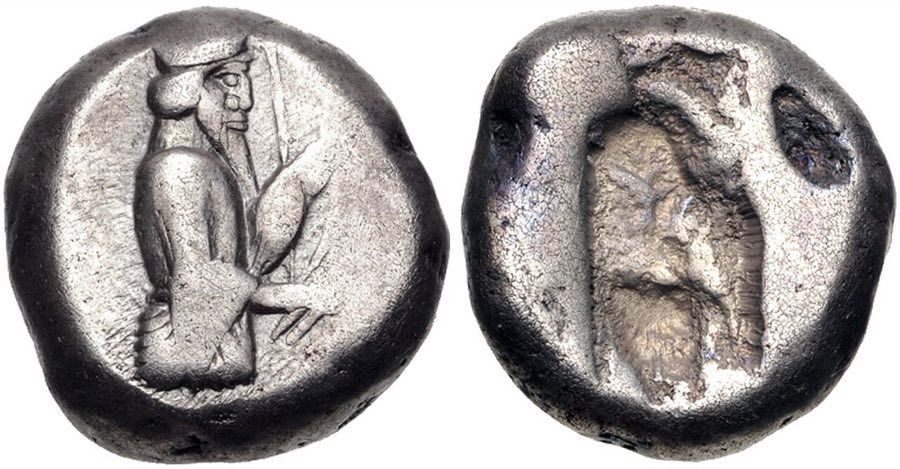
Darius I introduced the gold daric and silver siglos around 520 BCE, struck at Sardis for the western satrapies; the design of the royal archer stayed essentially unchanged for two centuries. Carradice's types I–IV trace the king's pose from half-figure to full running figure with spear, bow or dagger. Sigloi are usually heavily worn and covered in bankers' countermarks from circulation in Asia Minor and the Levant, and they are the affordable coin of the Persian Empire.
| Object | Coin |
|---|---|
| Dates | 520–330 BCE |
| Period | Achaemenid |
| Cultures | Achaemenid |
| Regions | Near East & Mesopotamia, Central Asia & Steppe |
Diagnostic traits
A thick bean-shaped silver coin of about 5.4 g showing the Persian king as a crowned archer kneeling-running with bow and spear or dagger, with an oblong incuse punch on the reverse.
Identification
The daric is the same design in gold and weighs about 8.4 g; Lydian Croeseids, the predecessor, show a lion and bull. Later satrapal coins name a satrap or show a Greek-style head. A siglos with no countermarks and full detail is unusual and deserves a close look.
Reproductions and fakes
Cast and struck forgeries exist for the daric especially; siglos forgeries are less common but modern strikes with soft detail and no countermarks appear in tourist markets. Genuine coins have a grainy surface, a deep irregular incuse and a dull grey tone.
Cite this article
Stratum Study. "Achaemenid siglos" (Artifact type). Stratum Study pack 2026.09, as of 2026-09-21. https://stratum.black/study/types/achaemenid-siglos. Accessed 2026-09-21.
@misc{stratum-achaemenid-siglos,
  title        = {Achaemenid siglos},
  author       = {{Stratum Study}},
  howpublished = {\url{https://stratum.black/study/types/achaemenid-siglos}},
  year         = {2026},
  note         = {Artifact type article, Stratum Study pack 2026.09, as of 2026-09-21; sources: stratum, commons. Accessed 2026-09-21.}
}
Citations carry the pack version and the article's as-of date so they resolve to the same text later. The facts themselves belong to the sources listed below; cite those for the science.