
Site · Jordan
Petra
Roman, 300 BCE–700 CE
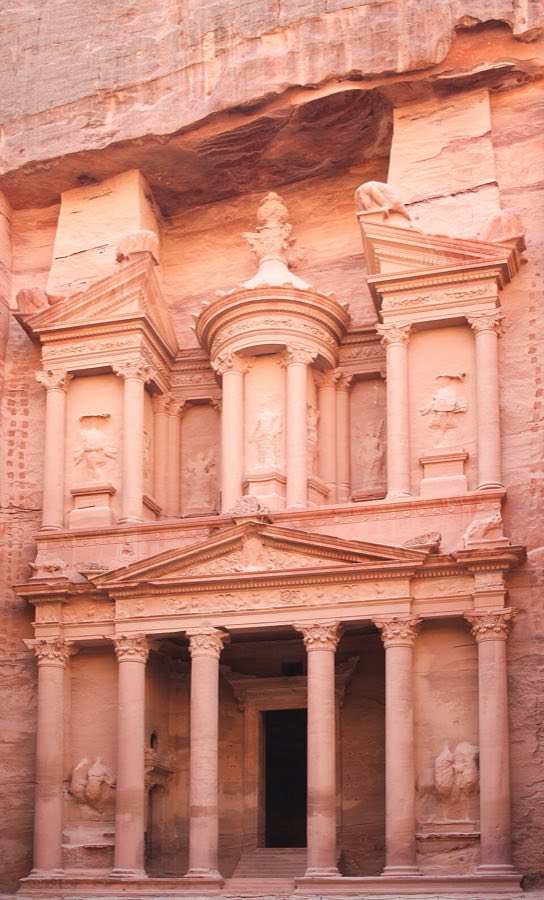
Petra is the rock-cut capital of the Nabataeans in southern Jordan, flourishing from the second century BCE, annexed by Rome in 106 CE and continuing into the Byzantine period. The Treasury, Monastery and Siq make it the most visited site in Jordan.
| Country | Jordan |
|---|---|
| State / province | Ma'an |
| Dates | 300 BCE–700 CE |
| Status | Archaeological park and UNESCO World Heritage Site |
| Managed by | Petra Development and Tourism Region Authority with the Department of Antiquities of Jordan |
| Access | Open to the public through the Siq to the Treasury and the city |
| Coordinates | 30.329, 35.444 (public site) |
What was found
Excavations recovered Nabataean painted fine ware, the Petra papyri from a Byzantine church, the Great Temple's theatron, marble sculpture, coins and the Treasury's rock-cut tombs. The water systems and hundreds of tomb façades are the monuments.
Rules
Nothing may be collected, dug, moved or removed at Petra; it is a protected archaeological site managed by Petra Development and Tourism Region Authority with the Department of Antiquities of Jordan, and taking artifacts, stones or samples is an offence. Jordanian law vests all antiquities in the state, and removal or export is a crime. This article is for study and context only and is not a collecting locality.
Elsewhere
Cite this article
Stratum Study. "Petra" (Site). Stratum Study pack 2026.09, as of 2026-09-21. https://stratum.black/study/sites/petra. Accessed 2026-09-21.
@misc{stratum-petra,
  title        = {Petra},
  author       = {{Stratum Study}},
  howpublished = {\url{https://stratum.black/study/sites/petra}},
  year         = {2026},
  note         = {Site article, Stratum Study pack 2026.09, as of 2026-09-21; sources: stratum, wikidata, commons. Accessed 2026-09-21.}
}
Citations carry the pack version and the article's as-of date so they resolve to the same text later. The facts themselves belong to the sources listed below; cite those for the science.