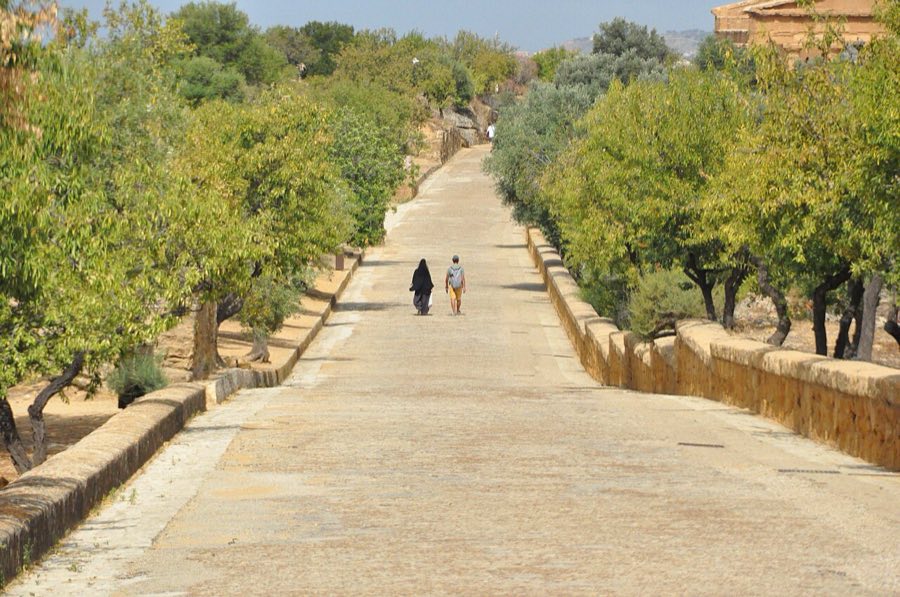

Site · Italy
Agrigento Valley of the Temples
Ancient Greece, Roman, 580 BCE–400 CE
Akragas was founded by Greek colonists in about 580 BCE and became one of the richest cities of the Greek world, building a row of Doric temples along its southern ridge in the fifth century; the Temple of Concordia survives almost intact because it became a church. Carthage sacked the city in 406 BCE and it lived on as Roman Agrigentum.
| Country | Italy |
|---|---|
| Dates | 580 BCE–400 CE |
| Status | Archaeological and Landscape Park and UNESCO World Heritage Site (1997) |
| Managed by | Parco Archeologico e Paesaggistico della Valle dei Templi |
| Access | Open daily with evening hours in summer; the park includes the temples on the ridge, the Hellenistic-Roman quarter and the Pietro Griffo regional museum. |
| Coordinates | 37.29, 13.585 (public site) |
What was found
Excavations since the nineteenth century recorded the Temple of Concordia, the colossal telamones of the Temple of Olympian Zeus, the Kolymbethra garden, sanctuaries of the chthonic deities, Greek pottery and coinage, and the mosaics of the Hellenistic-Roman houses.
Rules
Nothing may be collected; Italy's Code of Cultural Heritage (Legislative Decree 42/2004) and Sicilian regional heritage law make finds state property and forbid export without licence, and the US–Italy CPIA agreement restricts import of Sicilian antiquities. This article is for study and context only and is not a collecting locality.
Elsewhere
Cite this article
Stratum Study. "Agrigento Valley of the Temples" (Site). Stratum Study pack 2026.09, as of 2026-09-21. https://stratum.black/study/sites/agrigento-valley-of-the-temples. Accessed 2026-09-21.
@misc{stratum-agrigento-valley-of-the-temples,
  title        = {Agrigento Valley of the Temples},
  author       = {{Stratum Study}},
  howpublished = {\url{https://stratum.black/study/sites/agrigento-valley-of-the-temples}},
  year         = {2026},
  note         = {Site article, Stratum Study pack 2026.09, as of 2026-09-21; sources: stratum, commons. Accessed 2026-09-21.}
}
Citations carry the pack version and the article's as-of date so they resolve to the same text later. The facts themselves belong to the sources listed below; cite those for the science.