Culture · Mycenaean
Mycenaean
1600–1100 BCE, Europe — Mediterranean
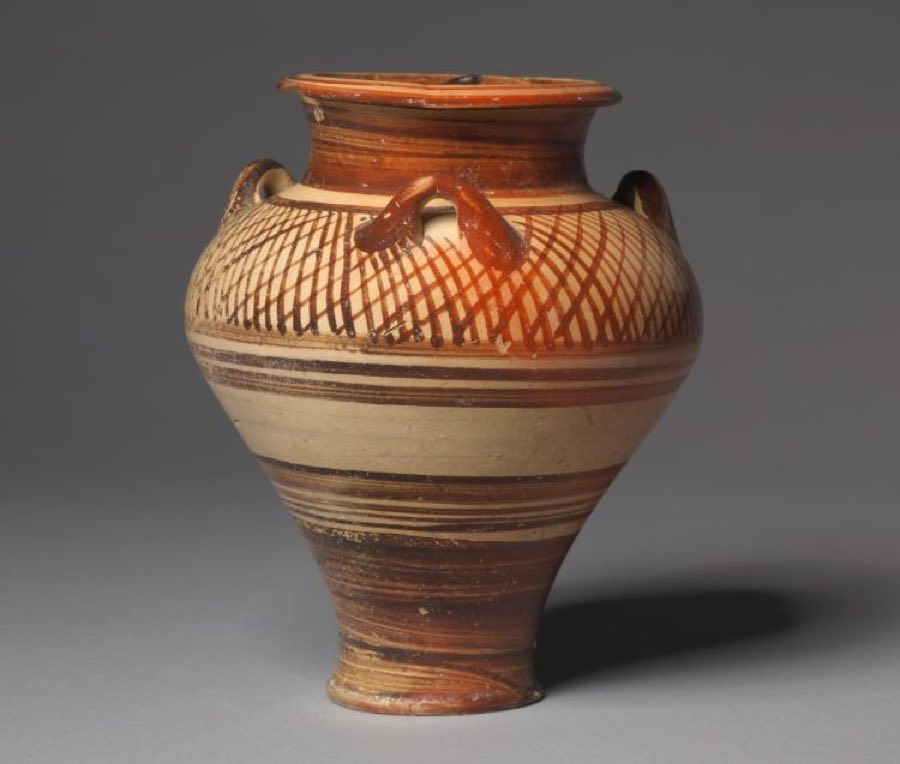
The Mycenaean civilisation is the palace-based Bronze Age culture of mainland Greece from about 1600 to 1100 BCE, centred on Mycenae, Tiryns, Pylos and Thebes and later ruling Knossos on Crete. Its rulers were buried in shaft graves and tholos tombs with gold masks, inlaid daggers and boars' tusk helmets, and its scribes kept Linear B accounts in Greek. Mycenaean pottery, stirrup jars, kylikes and kraters painted with octopuses, chariots and spirals, was exported across the Mediterranean from Italy to the Levant. The palaces burned around 1200 BCE at the end of the Bronze Age.
| Dates | 1600–1100 BCE |
|---|---|
| Period | Mycenaean |
| Region | Europe — Mediterranean |
| Areas | Peloponnese, Central Greece, Crete (after 1450 BCE), Aegean islands, Cyprus (trade) |
| Typical objects | Vessel, Jar, Figurine, Sword, Dagger, Seal, Bead |
| Typical materials | Terracotta, Bronze, Gold, Faience, Glass |
Identification
Mycenaean pottery is a fine, pale, well-levigated fabric with lustrous dark paint in the Furumark shape and motif series; Minoan pottery is earlier and more naturalistic, Geometric pottery later and angular. Phi and psi terracotta figurines of standing females with painted stripes are the commonest small finds. Bronze swords of the Naue II and horned types, and lentoid seals in hard stone, are characteristic.
Legality
Greek Law 3028/2002 declares all antiquities found in Greece to be state property, prohibits private trade without a licence and forbids export; Greece is a CPIA designated country for the United States (since 2011), so Mycenaean objects imported into the US need proof of lawful export or of presence outside Greece before the restriction date. Cyprus (designated since 2002) and Italy (since 2001) cover Mycenaean exports found there.
Reproductions and fakes
Mycenaean pottery is reproduced in Greece for tourists and occasionally aged; genuine paint is fired and slightly iridescent, whereas modern paint is flat and the fabric harder. Gold 'Mycenaean' jewellery is a favourite of forgers and should never be bought without laboratory examination.
Elsewhere
- Wikidata: Q181264
- Wikipedia: Mycenaean Greece
Cite this article
Stratum Study. "Mycenaean" (Culture). Stratum Study pack 2026.09, as of 2026-09-21. https://stratum.black/study/cultures/mycenaean. Accessed 2026-09-21.
@misc{stratum-mycenaean,
  title        = {Mycenaean},
  author       = {{Stratum Study}},
  howpublished = {\url{https://stratum.black/study/cultures/mycenaean}},
  year         = {2026},
  note         = {Culture article, Stratum Study pack 2026.09, as of 2026-09-21; sources: stratum, wikidata, cleveland. Accessed 2026-09-21.}
}
Citations carry the pack version and the article's as-of date so they resolve to the same text later. The facts themselves belong to the sources listed below; cite those for the science.