
Culture · Mississippian
Caddo
800–1800 CE, North America — Southeast
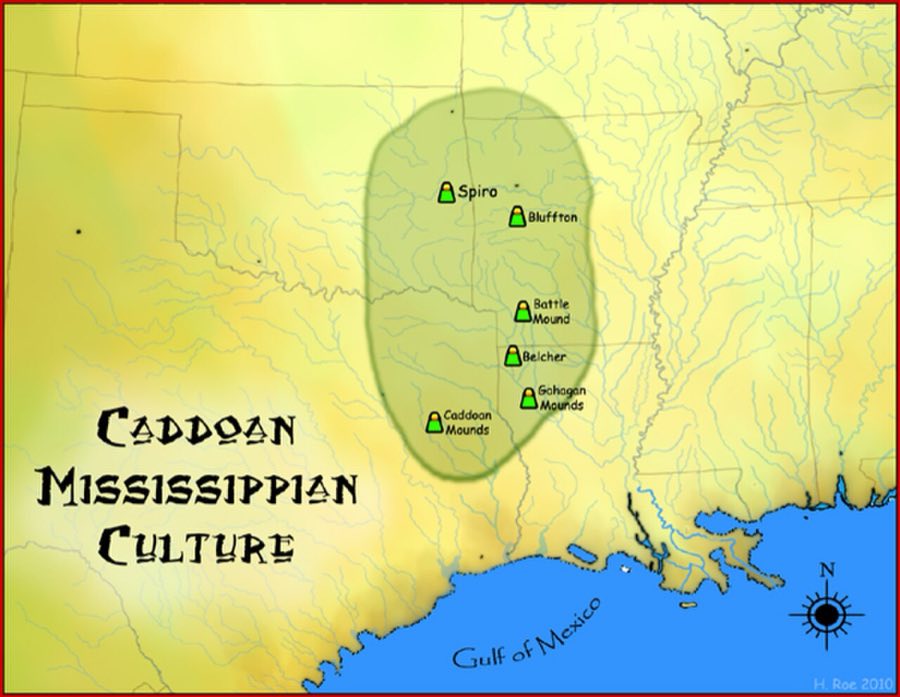
The Caddo were and are a people of the four-state area of Arkansas, Louisiana, Oklahoma and Texas whose ancestral culture flourished from about 800 CE into the colonial period. They built mound centres such as Spiro and Crenshaw and produced some of the finest pottery in North America. Collectors hold engraved bottles and bowls, Scallorn and Perdiz arrowpoints, novaculite blades and elbow pipes, though most fine vessels come from graves and the Caddo Nation actively seeks their repatriation.
| Dates | 800–1800 CE |
|---|---|
| Period | Mississippian |
| Region | North America — Southeast |
| Areas | Arkansas, East Texas, Louisiana, Oklahoma |
| Typical objects | Bottle, Bowl, Projectile point, Pipe |
| Typical materials | Grog-tempered earthenware, Novaculite, Chert |
Identification
Caddo pottery is thin, burnished and engraved with scrolls, spirals and ticked lines, often filled with red or white pigment, on long-necked bottles, carinated bowls and compound vessels. Grog and bone temper rather than shell are typical. Small corner-notched Scallorn and contracting-stem Perdiz points, Gahagan bifaces and novaculite are the lithic markers.
Legality
In the United States, prehistoric artifacts may be collected and sold only when they come from private land with the landowner's permission; removal from federal, tribal or most state land is prohibited under ARPA and state statutes. Funerary objects, human remains and sacred items are covered by NAGPRA and are not legitimately traded, and Canadian provinces treat archaeological finds as Crown or provincial property. Caddo engraved vessels are overwhelmingly grave goods, and the Caddo Nation has been active in NAGPRA claims and in objecting to auction sales, so provenance and ethical review are essential.
Reproductions and fakes
Caddo pottery has been reproduced by modern potters, some of them Caddo artists working openly, and such pieces later lose their signatures. Fakes are generally heavier, with engraved lines that are too even and lack ancient pigment residue, and surface burnish that does not show use scratching. Restored vessels with large painted infill are common and should be disclosed.
Cite this article
Stratum Study. "Caddo" (Culture). Stratum Study pack 2026.09, as of 2026-09-21. https://stratum.black/study/cultures/caddo. Accessed 2026-09-21.
@misc{stratum-caddo,
  title        = {Caddo},
  author       = {{Stratum Study}},
  howpublished = {\url{https://stratum.black/study/cultures/caddo}},
  year         = {2026},
  note         = {Culture article, Stratum Study pack 2026.09, as of 2026-09-21; sources: stratum, commons. Accessed 2026-09-21.}
}
Citations carry the pack version and the article's as-of date so they resolve to the same text later. The facts themselves belong to the sources listed below; cite those for the science.