
Material · lithic
Steatite
North America — Eastern Woodlands, North America — Southeast, Egypt & Nile Valley, Near East & Mesopotamia
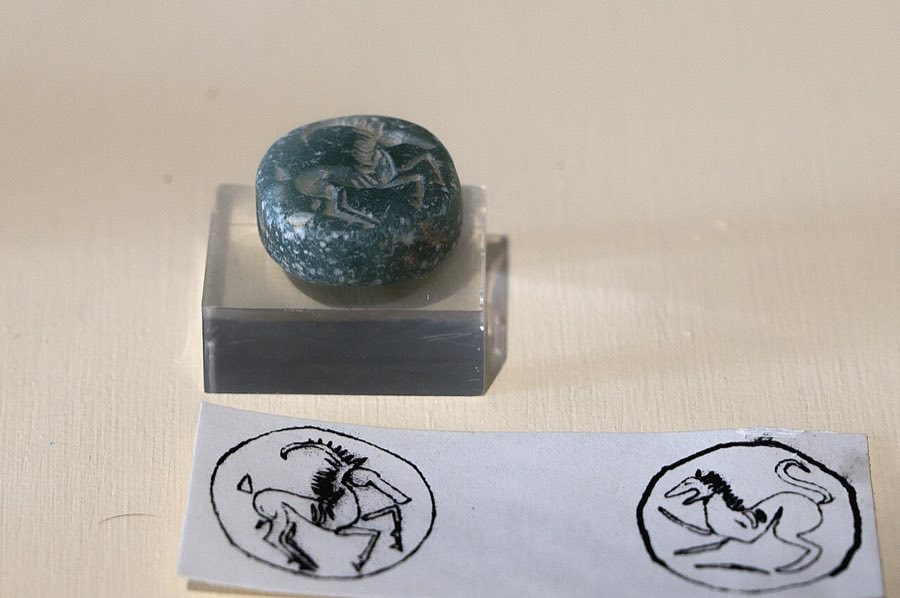
Steatite, or soapstone, is the soft talc-rich rock carved into bowls and pipes in the Eastern Woodlands and Southeast, into scarabs and vessels in Egypt, and into seals and vessels in the Near East. Late Archaic steatite bowls precede pottery in the Southeast. It is soft enough to cut with a knife.
| Kind | lithic |
|---|---|
| Regions | North America — Eastern Woodlands, North America — Southeast, Egypt & Nile Valley, Near East & Mesopotamia |
Sources
Sources include the Appalachian belt from Pennsylvania to Georgia with quarries such as Soapstone Ridge, the Sierra Nevada, Wadi Hammamat and Aswan in Egypt, the Iranian plateau and Tepe Yahya, and the Alps. Quarry faces often preserve the scars of bowls cut out of the bedrock.
Identification
Steatite is grey, green, brown or black, soapy to the touch, easily scratched with a fingernail, and shows carving and scraping marks; it fires hard when glazed, as in Egyptian scarabs. Weathering produces a lighter, chalky surface. Talc content varies.
Substitutes and fakes
Steatite is the easiest stone to carve and is the material of choice for forgers of pipes, scarabs, seals and Inuit-style carvings; look for rotary-tool marks and a uniform stain. Genuine pieces show ancient tool marks and worn edges.
Elsewhere
- Wikidata: Q707896
- Wikipedia: soapstone
Cite this article
Stratum Strata. "Steatite" (Material). Stratum Strata pack 2026.09, as of 2026-09-21. https://stratum.black/strata/materials/steatite. Accessed 2026-09-21.
@misc{stratum-steatite,
  title        = {Steatite},
  author       = {{Stratum Strata}},
  howpublished = {\url{https://stratum.black/strata/materials/steatite}},
  year         = {2026},
  note         = {Material article, Stratum Strata pack 2026.09, as of 2026-09-21; sources: stratum, commons, wikidata. Accessed 2026-09-21.}
}
Citations carry the pack version and the article's as-of date so they resolve to the same text later. The facts themselves belong to the sources listed below; cite those for the science.