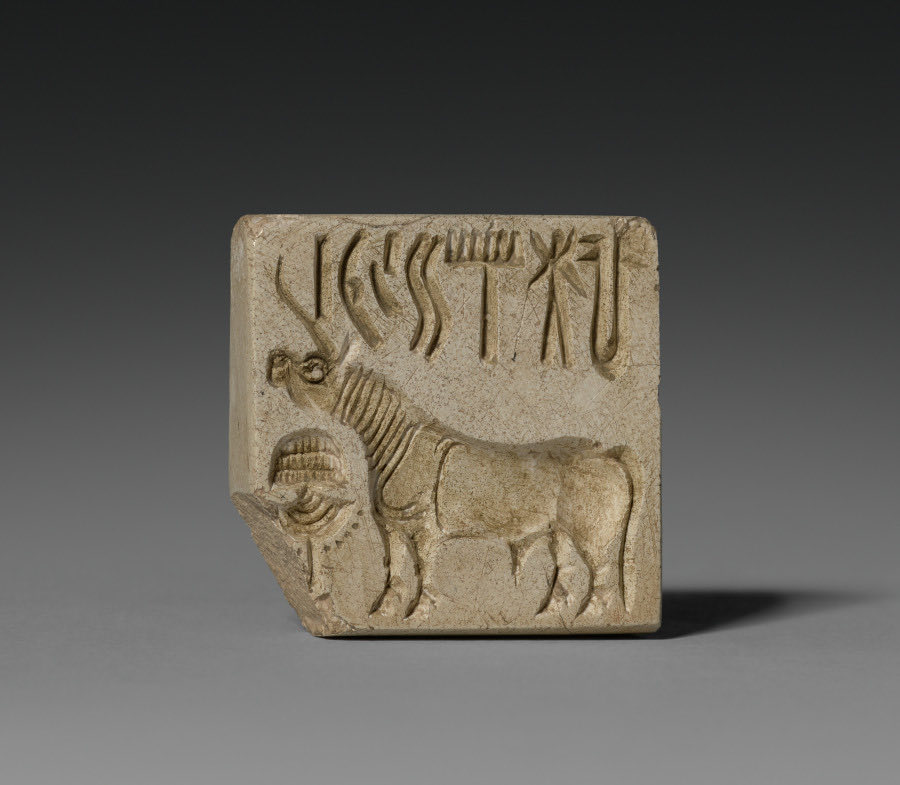
Culture · Harappan
Indus Valley
2600–1900 BCE, Near East & Mesopotamia
The Indus Civilisation is the Bronze Age urban culture of Pakistan and northwest India, with planned brick cities at Mohenjo-daro, Harappa, Dholavira and Rakhigarhi in its Mature phase of about 2600–1900 BCE. Its script remains undeciphered, and its best-known objects are the square steatite seals, long carnelian beads, shell bangles, terracotta figurines and toy carts, and painted black-on-red pottery. Indus traders reached Mesopotamia and the Gulf. Note that this app's region list has no South Asia entry; Indus material is filed under the Near East for convenience.
| Dates | 2600–1900 BCE |
|---|---|
| Period | Harappan |
| Region | Near East & Mesopotamia |
| Areas | Pakistan (Sindh, Punjab), Northwest India (Gujarat, Haryana, Rajasthan), Afghanistan (Shortugai) |
| Typical objects | Seal, Bead, Figurine, Vessel, Jar, Bracelet |
| Typical materials | Terracotta, Faience, Marine shell, Bronze, Steatite |
Identification
Indus seals are square with a boss; carnelian beads are etched with white designs or are long barrel beads drilled from both ends; terracotta figurines have applied pellet eyes and elaborate fan headdresses; bangles are cut from conch shell. Mesopotamian material of the same date uses cylinder seals and different pottery.
Legality
Pakistan's Antiquities Act (1975) and India's Antiquities and Art Treasures Act (1972) make antiquities state-controlled, prohibit their export without licence and require registration of objects held privately; India prohibits export of antiquities over 100 years old outright. Neither country has a CPIA agreement with the United States, but both pursue repatriation, and undocumented Indus material is a red flag.
Reproductions and fakes
Steatite seals and terracotta figurines are made for the tourist and online trade in Pakistan; fakes have fresh, glassy surfaces and invented script. Genuine seals have a matte whitened surface and string wear; genuine figurines are low-fired and soft.
Elsewhere
- Wikidata: Q137127055
Cite this article
Stratum Strata. "Indus Valley" (Culture). Stratum Strata pack 2026.09, as of 2026-09-21. https://stratum.black/strata/cultures/indus-valley. Accessed 2026-09-21.
@misc{stratum-indus-valley,
  title        = {Indus Valley},
  author       = {{Stratum Strata}},
  howpublished = {\url{https://stratum.black/strata/cultures/indus-valley}},
  year         = {2026},
  note         = {Culture article, Stratum Strata pack 2026.09, as of 2026-09-21; sources: stratum, wikidata, cleveland. Accessed 2026-09-21.}
}
Citations carry the pack version and the article's as-of date so they resolve to the same text later. The facts themselves belong to the sources listed below; cite those for the science.