Culture · Late Prehistoric
Hohokam
300–1450 CE, North America — Southwest
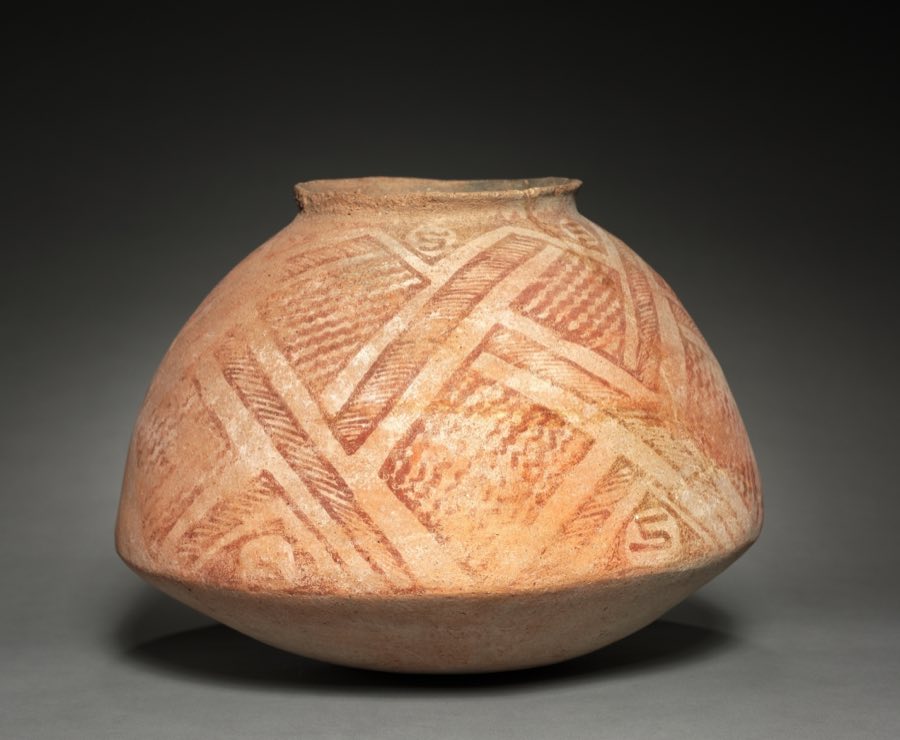
The Hohokam were the irrigation farmers of the Sonoran Desert of southern Arizona from about 300 to 1,450 CE, building canal networks, ballcourts and platform mounds around Phoenix and Tucson. They are considered ancestral to the O'odham peoples. Collectors hold red-on-buff pottery, etched and carved shell bracelets and pendants, stone palettes, three-quarter-grooved axes and small arrowpoints.
| Dates | 300–1450 CE |
|---|---|
| Period | Late Prehistoric |
| Region | North America — Southwest |
| Areas | Sonoran Desert, Southern Arizona |
| Typical objects | Jar, Bowl, Grooved axe, Bracelet, Pendant |
| Typical materials | Marine shell, Basalt, Chert, Turquoise |
Identification
Red-on-buff pottery with repeated small elements in red on a buff paddle-and-anvil body is unmistakable, as are Glycymeris shell bracelets, shell etched with acid designs and carved stone palettes with animal borders. Axes are long, three-quarter grooved and finely polished. Late Classic period sites add red ware and polychrome influenced by the Salado.
Legality
In the United States, prehistoric artifacts may be collected and sold only when they come from private land with the landowner's permission; removal from federal, tribal or most state land is prohibited under ARPA and state statutes. Funerary objects, human remains and sacred items are covered by NAGPRA and are not legitimately traded, and Canadian provinces treat archaeological finds as Crown or provincial property. Hohokam sites in Arizona lie on a mix of federal, state trust, tribal and private land, and cremation urns and palettes are funerary objects.
Reproductions and fakes
Hohokam shell jewellery and palettes are reproduced, and red-on-buff bowls have been faked for the tourist market since the 1930s. Modern shell work shows rotary grinding and bright, unweathered shell; genuine pieces are chalky and often burnt from cremations. Stone palettes with sharp, unworn edges and modern abrasive marks should be rejected.
Elsewhere
- Wikidata: Q1255768
- Wikipedia: Hohokam
Cite this article
Stratum Strata. "Hohokam" (Culture). Stratum Strata pack 2026.09, as of 2026-09-21. https://stratum.black/strata/cultures/hohokam. Accessed 2026-09-21.
@misc{stratum-hohokam,
  title        = {Hohokam},
  author       = {{Stratum Strata}},
  howpublished = {\url{https://stratum.black/strata/cultures/hohokam}},
  year         = {2026},
  note         = {Culture article, Stratum Strata pack 2026.09, as of 2026-09-21; sources: stratum, wikidata, cleveland. Accessed 2026-09-21.}
}
Citations carry the pack version and the article's as-of date so they resolve to the same text later. The facts themselves belong to the sources listed below; cite those for the science.