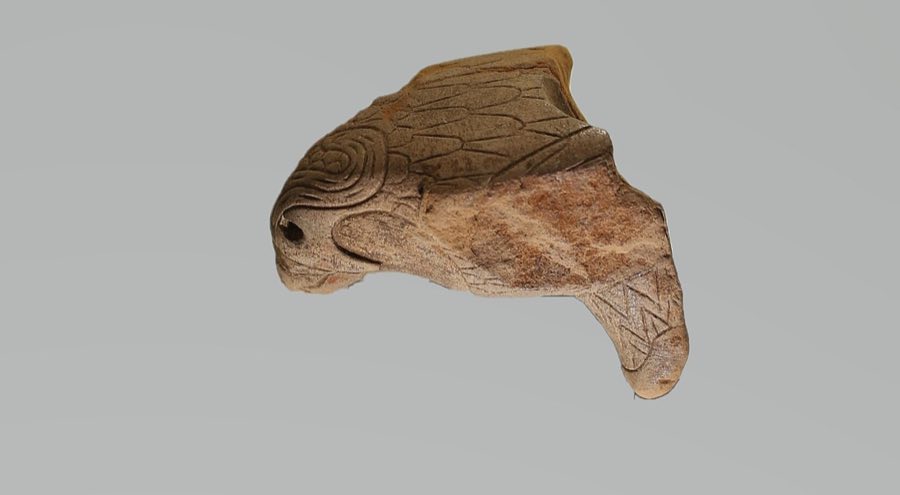

Pipe · Middle Woodland
Platform pipe
100 BCE–400 CE, Hopewell
The platform pipe is the smoking pipe of the Hopewell Middle Woodland, about 100 BCE to 400 CE, with a bowl set on a flat curved or straight base that also serves as the stem. Effigy examples carved as animals and birds from the Tremper and Mound City mounds are masterpieces of prehistoric art. Nearly all come from mound burials.
| Object | Pipe |
|---|---|
| Dates | 100 BCE–400 CE |
| Period | Middle Woodland |
| Cultures | Hopewell |
| Regions | North America — Eastern Woodlands |
Diagnostic traits
Flat curved or straight base with a central bowl, sometimes carved as an animal effigy; usually pipestone.
Identification
Platform pipes have a flat curved or straight base with a central bowl and a stem hole drilled through the base, unlike tubular pipes, which are cylindrical, and elbow pipes, which are L-shaped. Effigy pipes carry an animal facing the smoker. Ohio pipestone and steatite are typical.
Reproductions and fakes
Effigy platform pipes are among the most faked American antiquities; fakes are carved from pipestone and steatite with rotary tools and stained. Genuine pipes show reed-drilled bores and ancient tool marks. Plain platform pipes are also reproduced.
Cite this article
Stratum Study. "Platform pipe" (Artifact type). Stratum Study pack 2026.09, as of 2026-09-21. https://stratum.black/study/types/platform-pipe. Accessed 2026-09-21.
@misc{stratum-platform-pipe,
  title        = {Platform pipe},
  author       = {{Stratum Study}},
  howpublished = {\url{https://stratum.black/study/types/platform-pipe}},
  year         = {2026},
  note         = {Artifact type article, Stratum Study pack 2026.09, as of 2026-09-21; sources: stratum, commons. Accessed 2026-09-21.}
}
Citations carry the pack version and the article's as-of date so they resolve to the same text later. The facts themselves belong to the sources listed below; cite those for the science.