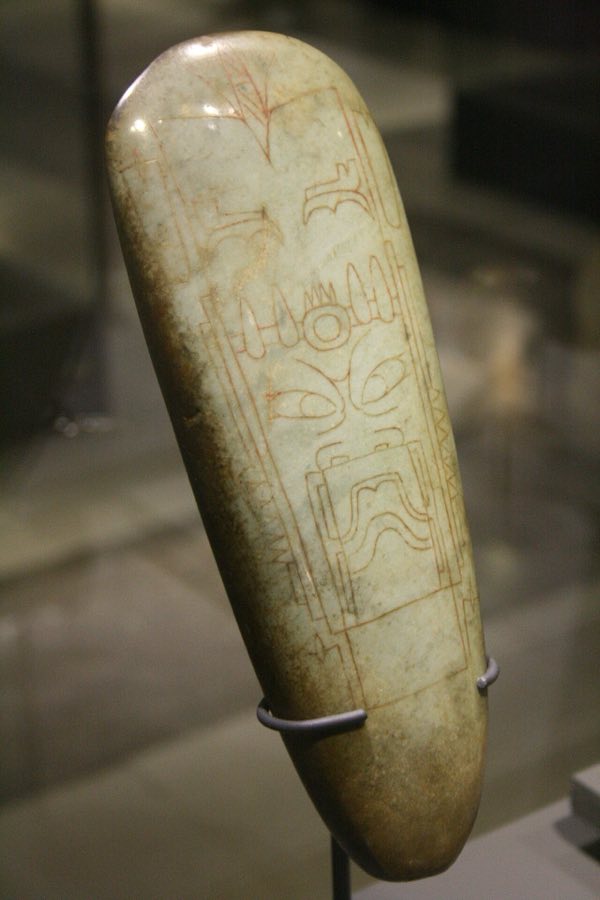

Celt · Late Preclassic
Olmec jade celt
1200–400 BCE, Olmec
The Olmec jade celt is a polished jadeite or serpentine axe-shaped votive of the Gulf Coast and highland Mexico, about 1,200 to 400 BCE, often incised with a were-jaguar face or a ruler figure. Celts were cached in groups at La Venta and other centres. They are among the most valuable and most forged Mesoamerican objects.
| Object | Celt |
|---|---|
| Dates | 1200–400 BCE |
| Period | Late Preclassic |
| Cultures | Olmec |
| Regions | Mesoamerica |
Diagnostic traits
Polished jadeite or serpentine axe-shaped votive, often incised with a were-jaguar face; found in caches.
Identification
Genuine Olmec celts are jadeite from the Motagua valley or serpentine, sawn with string and abrasive and polished to a soft lustre, unlike Maya celts, which are plainer, and modern lapidary work with rotary marks. Incising is shallow and confident. Blue-green jadeite is prized.
Reproductions and fakes
Extensively faked with rotary tools in dyed serpentine, quartz or modern jade; look for circular striations, artificial patina in the incising and an over-elaborate face. Provenance from a documented pre-1972 collection is essential.
Cite this article
Stratum Study. "Olmec jade celt" (Artifact type). Stratum Study pack 2026.09, as of 2026-09-21. https://stratum.black/study/types/olmec-jade-celt. Accessed 2026-09-21.
@misc{stratum-olmec-jade-celt,
  title        = {Olmec jade celt},
  author       = {{Stratum Study}},
  howpublished = {\url{https://stratum.black/study/types/olmec-jade-celt}},
  year         = {2026},
  note         = {Artifact type article, Stratum Study pack 2026.09, as of 2026-09-21; sources: stratum, commons. Accessed 2026-09-21.}
}
Citations carry the pack version and the article's as-of date so they resolve to the same text later. The facts themselves belong to the sources listed below; cite those for the science.