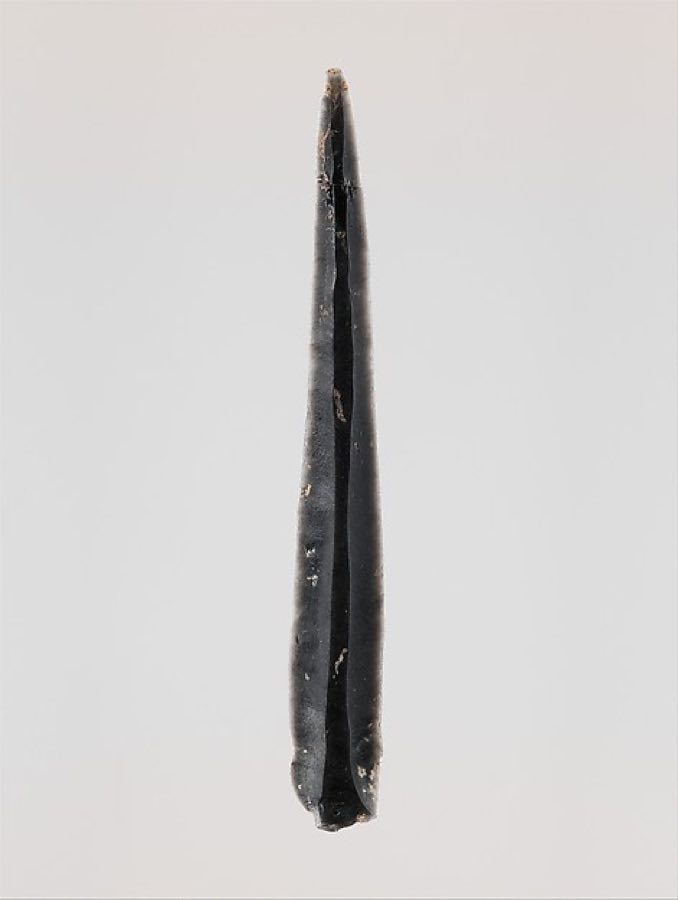
Blade · Late Postclassic
Obsidian prismatic blade
1500 BCE–1521 CE, Teotihuacan, Maya, Aztec
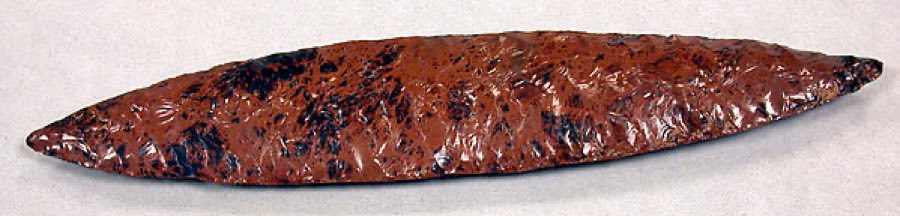
The obsidian prismatic blade is the razor-sharp cutting tool of Mesoamerica from the Preclassic to the conquest, about 1,500 BCE to 1,521 CE, struck by pressure from a polyhedral core. Teotihuacan, the Maya and the Aztec all used them for everyday cutting, bloodletting and weapons. Blades and exhausted cores are the commonest Mesoamerican finds.
| Object | Blade |
|---|---|
| Dates | 1500 BCE–1521 CE |
| Period | Late Postclassic |
| Cultures | Teotihuacan, Maya, Aztec |
| Regions | Mesoamerica |
Diagnostic traits
Long, narrow pressure blade with a trapezoidal section struck from a polyhedral core; green Pachuca obsidian favoured at Teotihuacan.
Identification
Prismatic blades are long, narrow and trapezoidal in section with parallel edges and a tiny platform, unlike casual flakes, and unlike European Neolithic blades in their glass material. Green Pachuca obsidian marks Teotihuacan; grey and black sources are traced by chemistry. Cores are bullet-shaped.
Reproductions and fakes
Blades are produced today by demonstrators and by Teotihuacan-area workshops for sale; genuine blades show slight edge dulling and, under a microscope, hydration. They are rarely faked deliberately but are often misattributed by site.
Photographs
Elsewhere
- met: 632266
Cite this article
Stratum Study. "Obsidian prismatic blade" (Artifact type). Stratum Study pack 2026.09, as of 2026-09-21. https://stratum.black/study/types/obsidian-prismatic-blade. Accessed 2026-09-21.
@misc{stratum-obsidian-prismatic-blade,
  title        = {Obsidian prismatic blade},
  author       = {{Stratum Study}},
  howpublished = {\url{https://stratum.black/study/types/obsidian-prismatic-blade}},
  year         = {2026},
  note         = {Artifact type article, Stratum Study pack 2026.09, as of 2026-09-21; sources: stratum, met. Accessed 2026-09-21.}
}
Citations carry the pack version and the article's as-of date so they resolve to the same text later. The facts themselves belong to the sources listed below; cite those for the science.