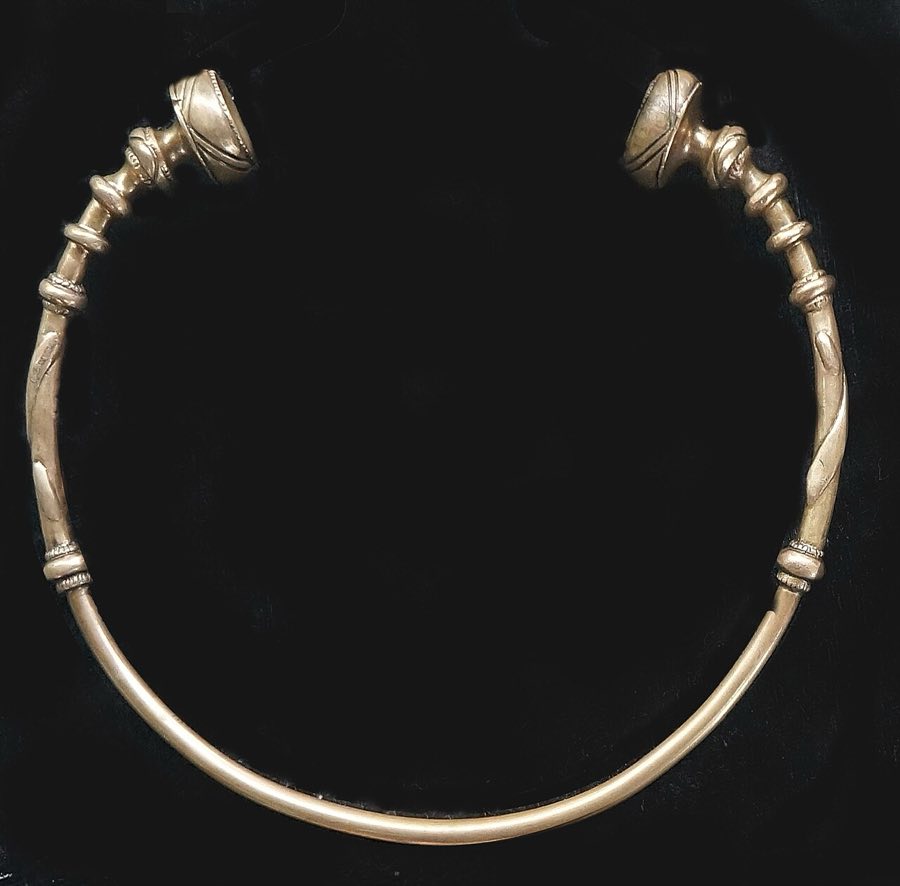

Torc · La Tène
La Tène torc
450–50 BCE, La Tène
Torcs were the principal marker of rank in the Celtic world from the fifth century BCE to the Roman conquest, worn by women in Champagne and Bohemia and by men and gods in Britain and Gaul. Bronze buffer torcs from Continental graves are the commonest; the twisted gold and electrum torcs of the Snettisham and Ipswich hoards are the pinnacle. Dealers see chiefly bronze fragments and small ring-terminal examples.
| Object | Torc |
|---|---|
| Dates | 450–50 BCE |
| Period | La Tène |
| Cultures | La Tène |
| Regions | Europe — Western & Central, Europe — Northern & British Isles |
Diagnostic traits
A rigid neck ring of bronze, gold or electrum, either a plain or twisted bar or a hollow tube, with buffer, knob or loop terminals, often decorated with La Tène curvilinear relief.
Identification
A torc is rigid and opens at the front, unlike a bracelet, and is too large for a wrist; La Tène decoration of running scrolls, trumpets and lobes separates it from Bronze Age twisted torcs, which are plain and much earlier. Roman and Viking neck rings are simpler, and Viking rings are usually silver and plaited.
Reproductions and fakes
Cast bronze copies of Champagne buffer torcs circulate with sprayed green patina; genuine torcs have wear on the inside of the ring and terminals, a patina that varies across the surface and often soil in the recesses of the relief. Gold torcs are faked in gilt bronze; check weight and colour.
Cite this article
Stratum Study. "La Tène torc" (Artifact type). Stratum Study pack 2026.09, as of 2026-09-21. https://stratum.black/study/types/la-tene-torc. Accessed 2026-09-21.
@misc{stratum-la-tene-torc,
  title        = {La Tène torc},
  author       = {{Stratum Study}},
  howpublished = {\url{https://stratum.black/study/types/la-tene-torc}},
  year         = {2026},
  note         = {Artifact type article, Stratum Study pack 2026.09, as of 2026-09-21; sources: stratum, commons. Accessed 2026-09-21.}
}
Citations carry the pack version and the article's as-of date so they resolve to the same text later. The facts themselves belong to the sources listed below; cite those for the science.