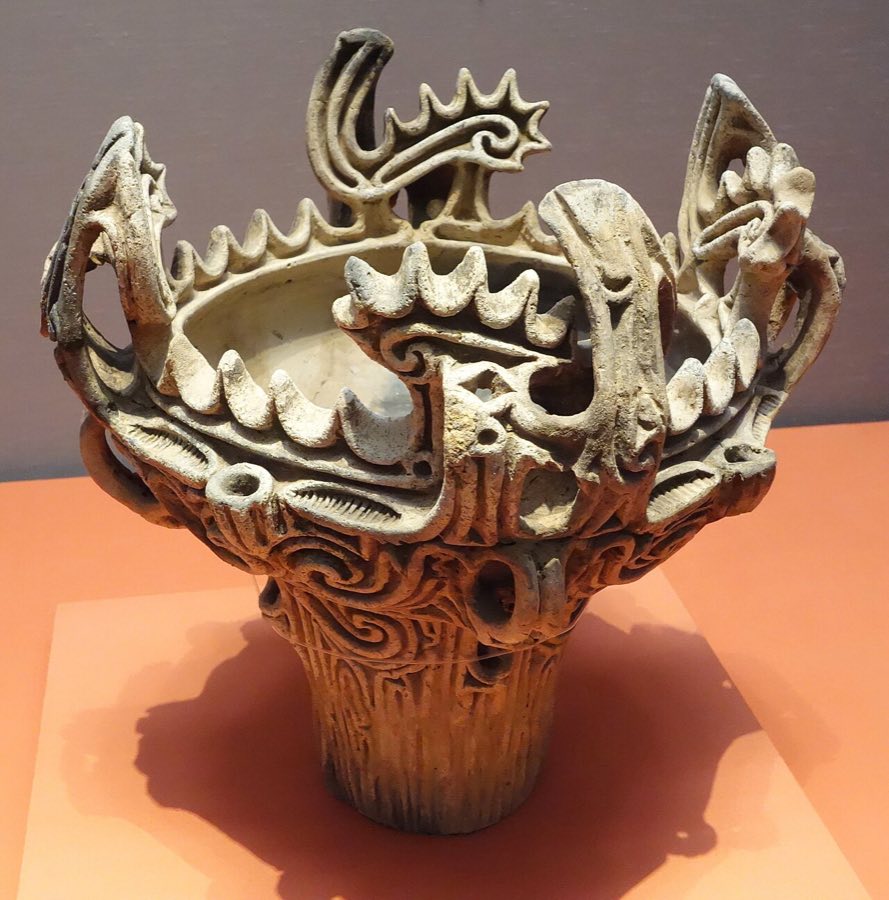

Jar · Jomon
Jomon vessel
10500–300 BCE, Jomon
Jomon pottery is among the oldest in the world, beginning before 10,000 BCE, and takes its name from the cord marking (jōmon) that covers most vessels. The Middle Jomon 'flame' pots of Niigata (about 3500–2500 BCE) with their sculptural rims are the most spectacular; Late and Final Jomon vessels are finer, with burnished zoned decoration. Complete vessels are almost all in Japanese museums; the trade sees sherds and restored pieces from old collections.
| Object | Jar |
|---|---|
| Dates | 10500–300 BCE |
| Period | Jomon |
| Cultures | Jomon |
| Regions | East Asia |
Diagnostic traits
A hand-built, low-fired earthenware jar with a rounded or pointed base, a flaring rim, and surface decoration impressed with twisted cord, sometimes with elaborate sculptural flame-like rim projections.
Identification
Cord marking, a pointed or narrow base and the absence of a wheel identify Jomon; Yayoi pottery that followed is wheel-finished, thin and plain, and Chinese Neolithic wares are painted or burnished. Deep bowls dominate the Early and Middle periods; spouted vessels and lamps appear later.
Reproductions and fakes
Restored vessels made up from unrelated sherds with painted fill are the main problem; look at the interior for consistency of fabric. Modern reproductions are fired harder and lack the soft, low-fired, blackened fabric of the originals. Export from Japan of designated cultural property is prohibited.
Cite this article
Stratum Study. "Jomon vessel" (Artifact type). Stratum Study pack 2026.09, as of 2026-09-21. https://stratum.black/study/types/jomon-vessel. Accessed 2026-09-21.
@misc{stratum-jomon-vessel,
  title        = {Jomon vessel},
  author       = {{Stratum Study}},
  howpublished = {\url{https://stratum.black/study/types/jomon-vessel}},
  year         = {2026},
  note         = {Artifact type article, Stratum Study pack 2026.09, as of 2026-09-21; sources: stratum, commons. Accessed 2026-09-21.}
}
Citations carry the pack version and the article's as-of date so they resolve to the same text later. The facts themselves belong to the sources listed below; cite those for the science.