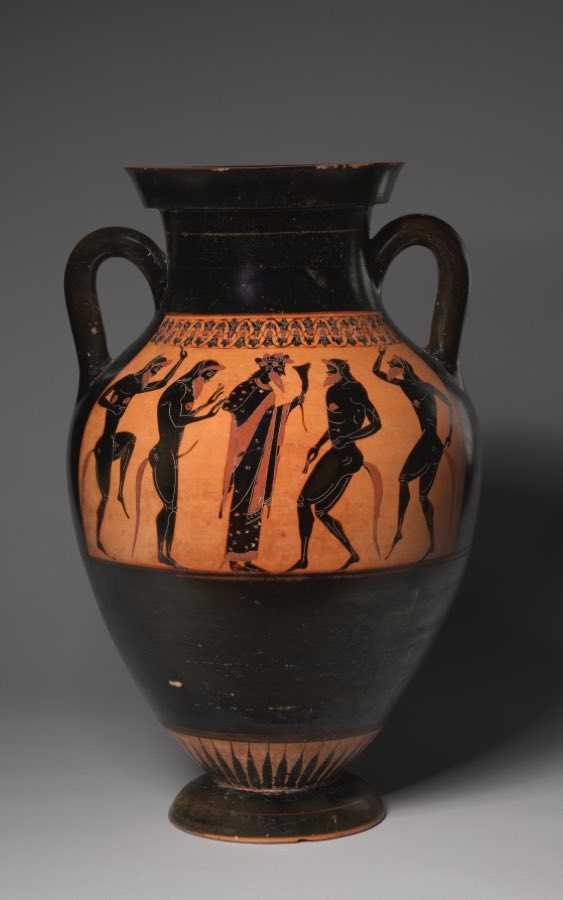
Amphora · Archaic Greek
Greek black-figure amphora
620–480 BCE, Ancient Greece
The Greek black-figure amphora is the two-handled storage and display vessel painted with figures in black slip on the red clay, incised for detail, made chiefly in Athens from about 620 to 480 BCE. Panathenaic amphorae held prize oil. Painters such as Exekias are identified by style, and the technique preceded red-figure.
| Object | Amphora |
|---|---|
| Dates | 620–480 BCE |
| Period | Archaic Greek |
| Cultures | Ancient Greece |
| Regions | Europe — Mediterranean |
Diagnostic traits
Two-handled storage vessel with figures painted in black slip against the red clay, details incised and added in red and white.
Identification
Figures are black silhouettes with incised details and added red and white, unlike red-figure, where figures are reserved in clay colour. Corinthian black-figure has a pale fabric and animal friezes. Shapes include belly, neck and Panathenaic amphorae.
Reproductions and fakes
Restored and repainted, with missing figures completed; ultraviolet and solvent tests reveal it. Outright fakes are rare but known, and fragments are assembled into vessels.
Cite this article
Stratum Study. "Greek black-figure amphora" (Artifact type). Stratum Study pack 2026.09, as of 2026-09-21. https://stratum.black/study/types/greek-black-figure-amphora. Accessed 2026-09-21.
@misc{stratum-greek-black-figure-amphora,
  title        = {Greek black-figure amphora},
  author       = {{Stratum Study}},
  howpublished = {\url{https://stratum.black/study/types/greek-black-figure-amphora}},
  year         = {2026},
  note         = {Artifact type article, Stratum Study pack 2026.09, as of 2026-09-21; sources: stratum, cleveland. Accessed 2026-09-21.}
}
Citations carry the pack version and the article's as-of date so they resolve to the same text later. The facts themselves belong to the sources listed below; cite those for the science.